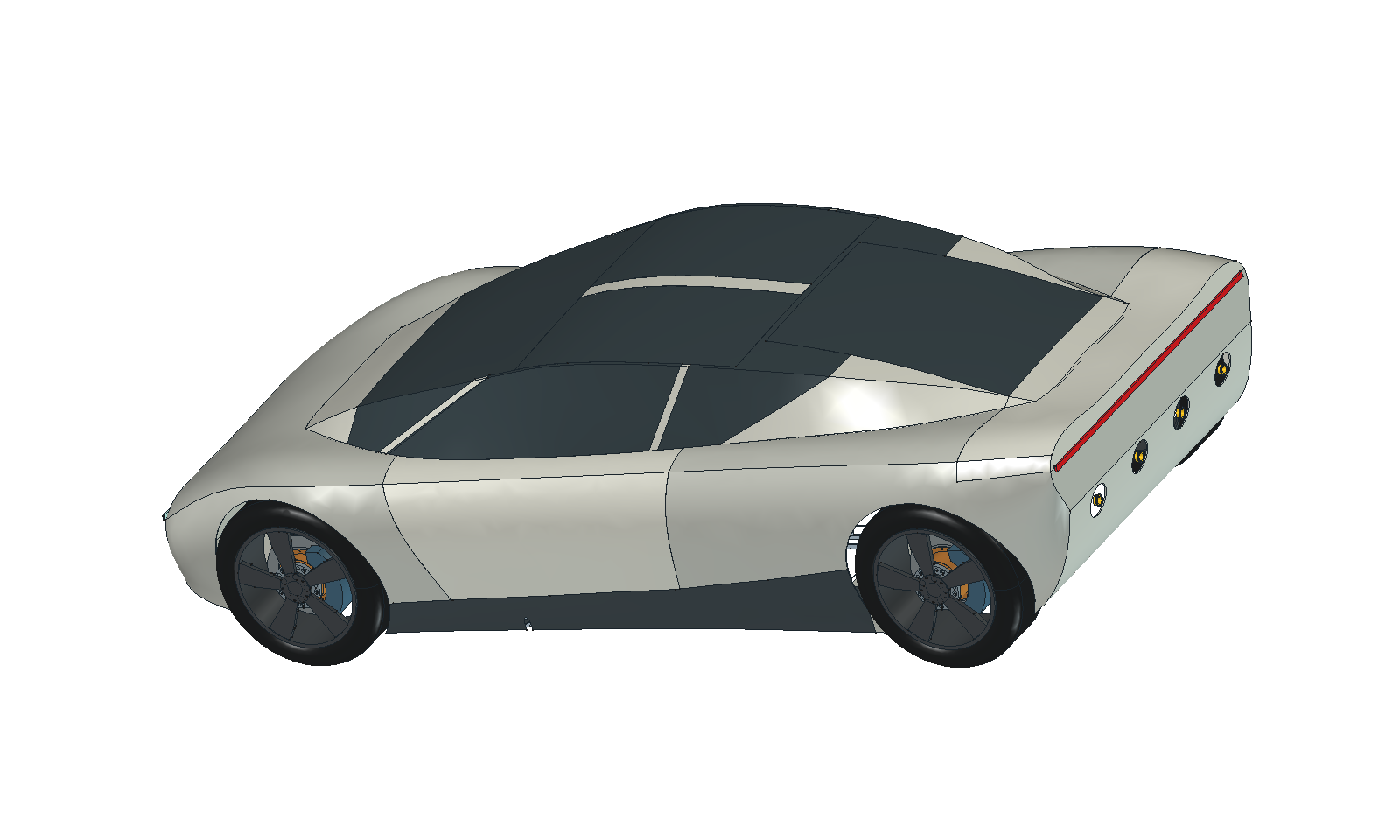
The committee will select a C6I architecture for the “original +20%” objective. DEV45 starts with a review of the saved DEV44 calculations. The immediate decision is to approve the three rig programmes and appoint an owner for each measurement campaign.
Archived CAD view · assembled C6I within its original body envelope.
What DEV44 demonstrated
5 m series · 0/4
The run called for the centre of mass (CoM) to reach a world-frame height of 2.50 m, followed by a yaw turn and a four-wheel landing. The simulation stopped at the rear-left (RL) strut rod speed limit.
Peak CoM height
1.636 m
Four-wheel hold
0.00 s
Peak RL rod speed
1.0502 m/s
AIR consumed
98.42 kg
Auxiliary bus energy
0.00238 kWh
Limit for each rod
1.00 m/s
In a separate low return without a yaw turn, the CoM rose 0.204 m from its starting position. The four-wheel hold lasted 0.50 s with a peak rod speed of 0.7638 m/s. This return consumed 105.59 kg of AIR and 0.00397 kWh. Both energy figures cover the onboard auxiliaries over the recorded interval. Energy for the external refill and recovery station remains open.
At 0.2685 s the demand reached 160.20 kg/s against 159.83 kg/s available. The reserve still held 62.59 kg when the run stopped. The plot includes losses in the adapter. Select the plot for a full-size view.
Three variants for committee review
Decision open
V1
Single AIR-driven C6I
One road and stunt configuration, with no external rotors. Evaluate a dry-mass target of 2,800 kg, independent supplies and thermal assistance.
Select once mass, flow, thermal balance and landing reserve are substantiated at the lower bounds of measured performance.
V2
Alternative working fluid
Commission a preliminary review of a complete module using another working fluid if the AIR scheme falls short on mass and usable inventory.
A separate development requires an owner decision, an external interface specification and an independent review.
V3
C6I-Flight and C6I-Track
Two configurations on one platform. Flight undergoes flight and landing tests. Track completes the road programme.
Verify each vehicle’s mass, packaging and resource budgets. Maintain separate configuration records and acceptance results.
Interpreting “+20%”. First establish the original configuration, measurement method and uncertainty. For higher-is-better metrics, the target is ≥1.20 times the original upper bound. For elapsed time and consumption, it is ≤0.80 times the original lower bound. Compare specific and total resource use for the same completed task.
Three test rigs at DEV45 entry
Measurements pending
The package documents the scope of the saved calculations. Qualifying each measured map requires calibration, synchronised raw records, validity range and uncertainty. The committee appoints the owners and approves the test envelope for each rig.
AIR_BENCH
Pneumatics
Characterise the T400 and reserve supplies separately and together as pressure falls.
Deliver lower bounds for flow and force, delays, temperature range and mass balance. The DEV44 rig record carries the status OPEN_DATA.
Test FL_W0/W1 and FL_W0/S0 at ±4.375 mm differential travel, at 15/225 mm positions and with 1–15 mm gaps.
Deliver synchronised S1–S4 records for travel, force, leakage, pressure and cable holding under fault conditions. Record when the last segment deploys for the 128/128 check. Accepted measurements are pending.
Standing RU/EN release rule. Each TextToCAD release includes complete Russian and English editions with one document ID, revision and date. Both editions preserve requirement and test IDs, the configuration, physical values, units, precision, status and links to the same evidence. Any threshold, source record or status change updates both editions. Check these fields for parity before release.