C.400 P.2 · R6E2 CFD · 15.11.2026
Atar 101D.V gas path
The literal R6E1 tailpipe at 195.45 kPa total pressure passes 77.36 kg/s. This is about 52% higher than the prior engine balance of 50.87 kg/s.
Thrust and flow in the main nozzle
CAD exit area is 0.3097 m². The last cells reach M ≈ 0.98. At the same total conditions, a radially scaled flow path with 0.2037 m² at the exit gives the prior flow and 29.49 kN. Mass flow determines the scenario area. Thrust is evaluated afterwards. The other hypothesis keeps CAD area and requires about 139.95 kPa nozzle-inlet total pressure.
F is the axial reaction of the main outlet from momentum and exit pressure relative to a 101.325 kPa ambient. The archival value describes the complete 101D.V. Inlet losses and lateral-jet forces are unresolved. Archival test boundary conditions remain unknown.
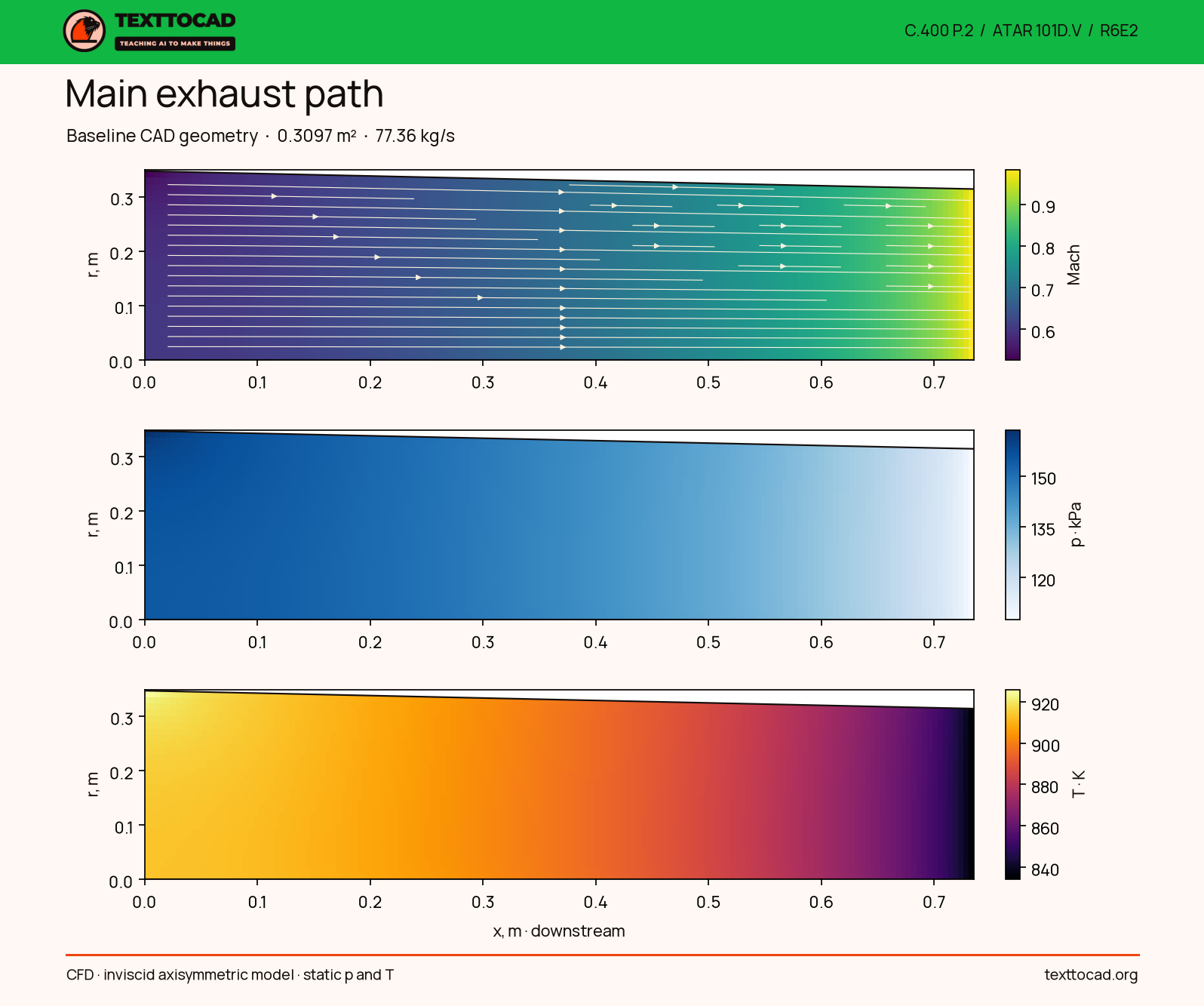 CAD nozzle, R6E1 total conditions · VTK
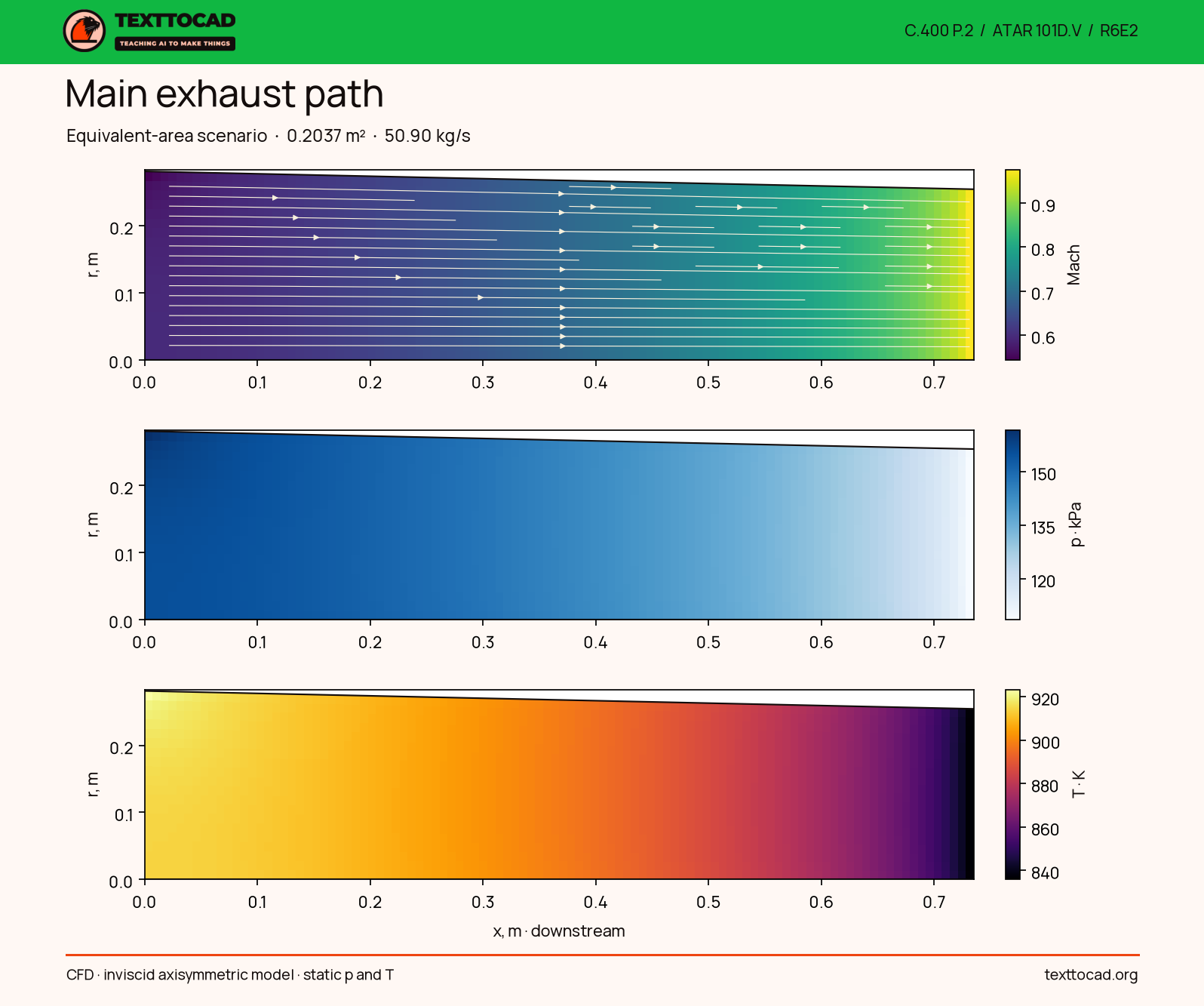 Equivalent area, mass-matched scenario · VTK
Bleed downstream of stage three
The axisymmetric bleed section uses 211 and 394 mm FreeCAD radii. The 6 mm slot and back pressure define the scenario. Mass extraction is solved for. At 168 kPa, it is 1.36 kg/s on the medium mesh and 1.76 kg/s on the most refined mesh. The last refinement changes it by 12.9%. The fine 155 kPa case gives 2.36 kg/s (4.37%).
AAMS reports about 4% for the described condition with sector injection. The outlet pressure of the physical bleed duct remains unknown. AAMS · p. 34
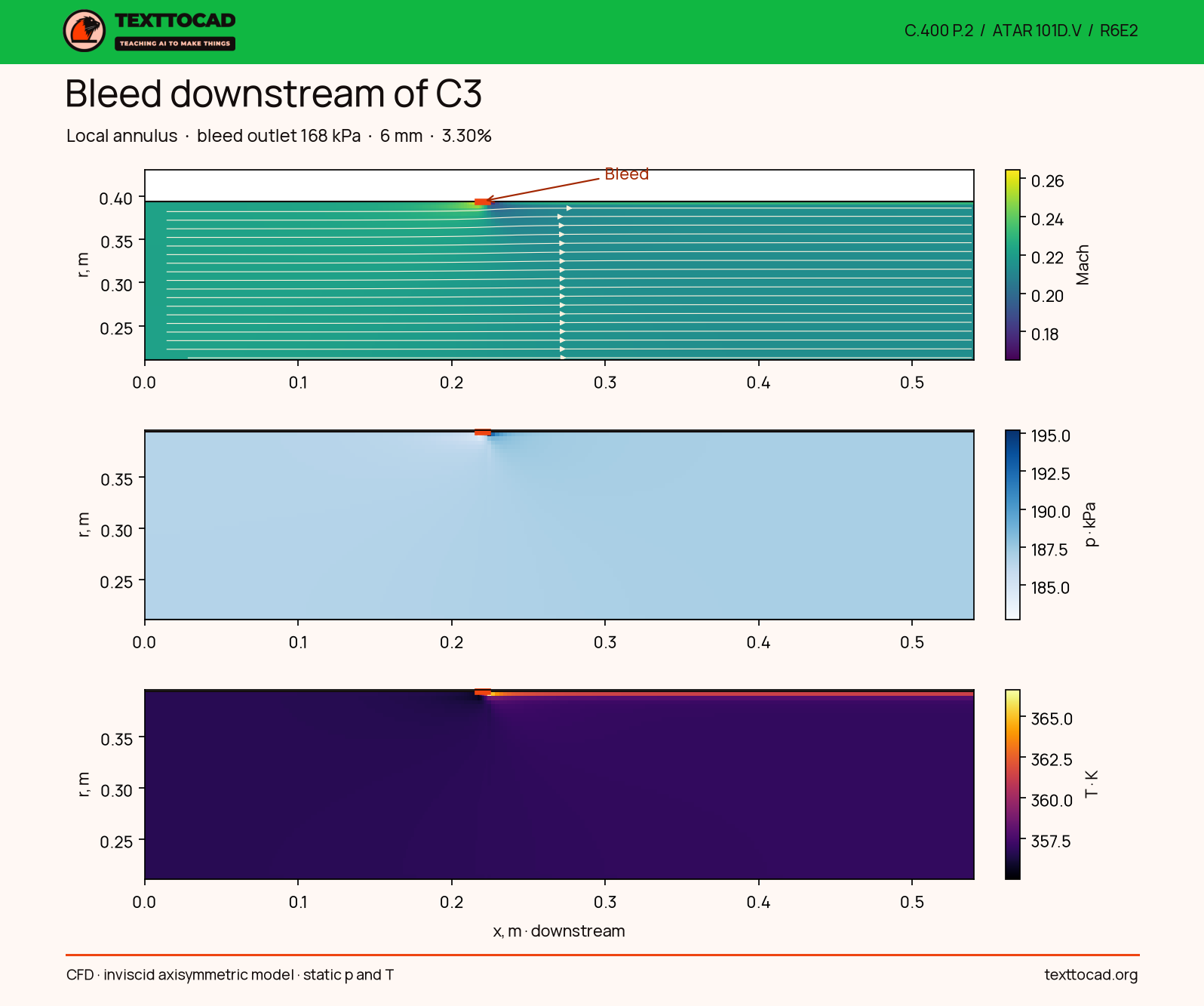 168 kPa · most refined mesh · VTK
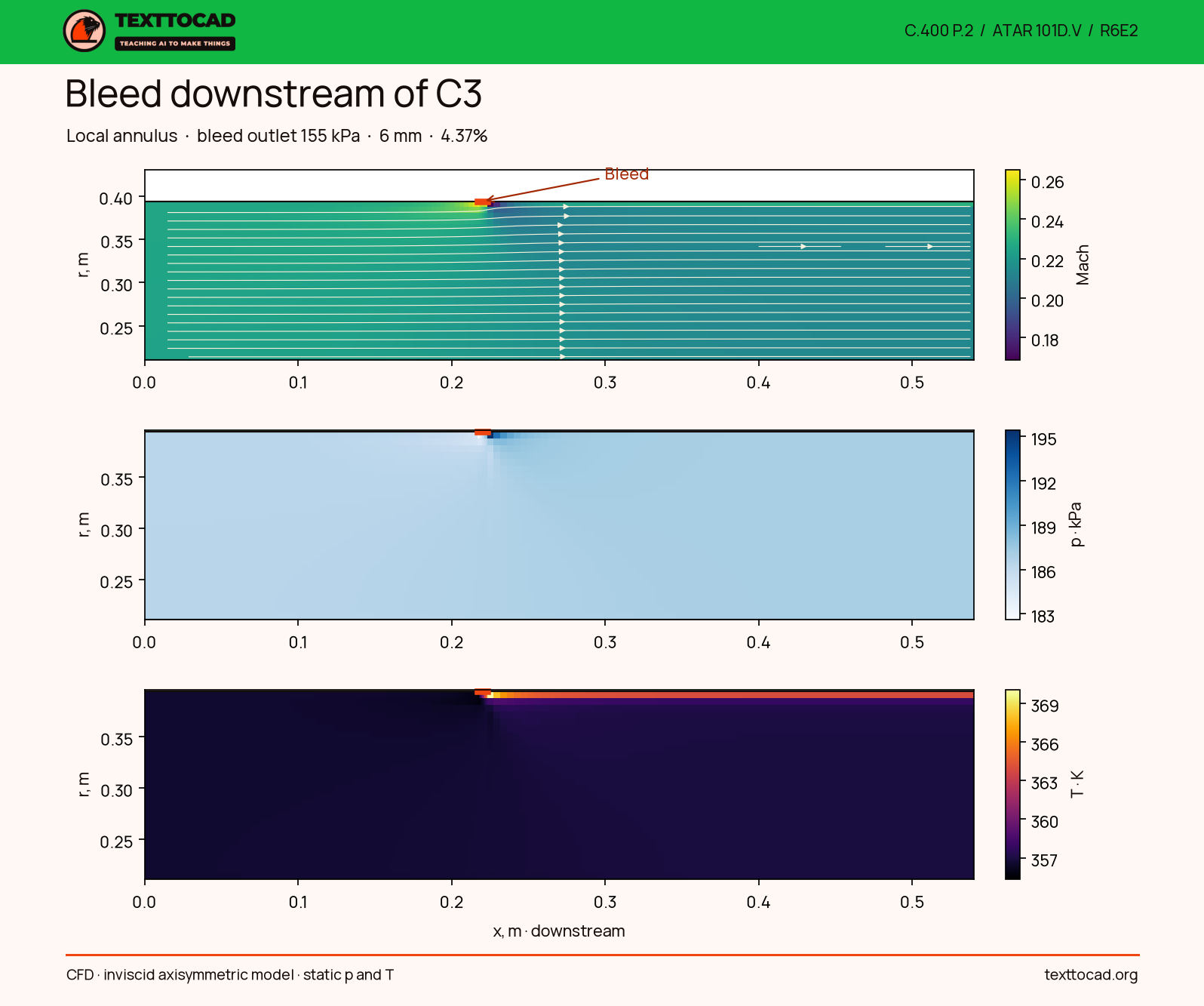 155 kPa · fine mesh · VTK
Verification and FeedBack
Euler simulations omit viscosity, heat transfer, turbulence, rotating blades and individual bleed ports. The nozzle is axisymmetric. Four-sector injection and its interaction with the hot jet require 3D geometry, measured mass flow and validation. Fields near the slot are sensitive to grid and outlet treatment. Local extrema depend on the model setup.
Converged runs 14. Maximum mass imbalance 0.049%. Nozzle force spread across 3 meshes 0.118%.