TextToCAD
ManoeuvresRU

ROADSTER ROCKET / DEV36

Roadster upgrade specification

Seven episodes connect the C6I baseline, CARBON targets and acceptance criteria. The ramp has two trajectories and the flat yaw turn has two directions.

External package simulation

At a 5,447 kg starting mass, the 2.50 m hover lasted 8.16 s and the controlled turn took 3.804 s. Peak rod speed was 0.127 m/s and four-wheel dwell reached 0.650 s. The cycle used 29.845 kg AIR and 16.297 kWh from the battery. Peak demand was 5.741 MW.

This external electric package spans 4.793 m, compared with a baseline body width of 2.032 m. With the bus limited to 550 kW the vehicle stays on the pad. Bench maps, packaging, strength, repeatability and full-programme margin remain open.

DEV37 · In-body AIR cycle

The dual-feed study reached 2.524 m. The turn and four-wheel dwell remain open. The standard air supply limits the in-body configuration.

Coupled trial · Yaw from prescribed height

DEV38 · Protective landing and full numerical cycle

The 600 L run reached 1.60 m and completed a protective landing. The rotorless numerical cycle passed with a 1,068 L charge. Packaging that charge in C6I remains open.

600 L limit · Full cycle and consumption

DEV39 · Packaging and AIR reduction

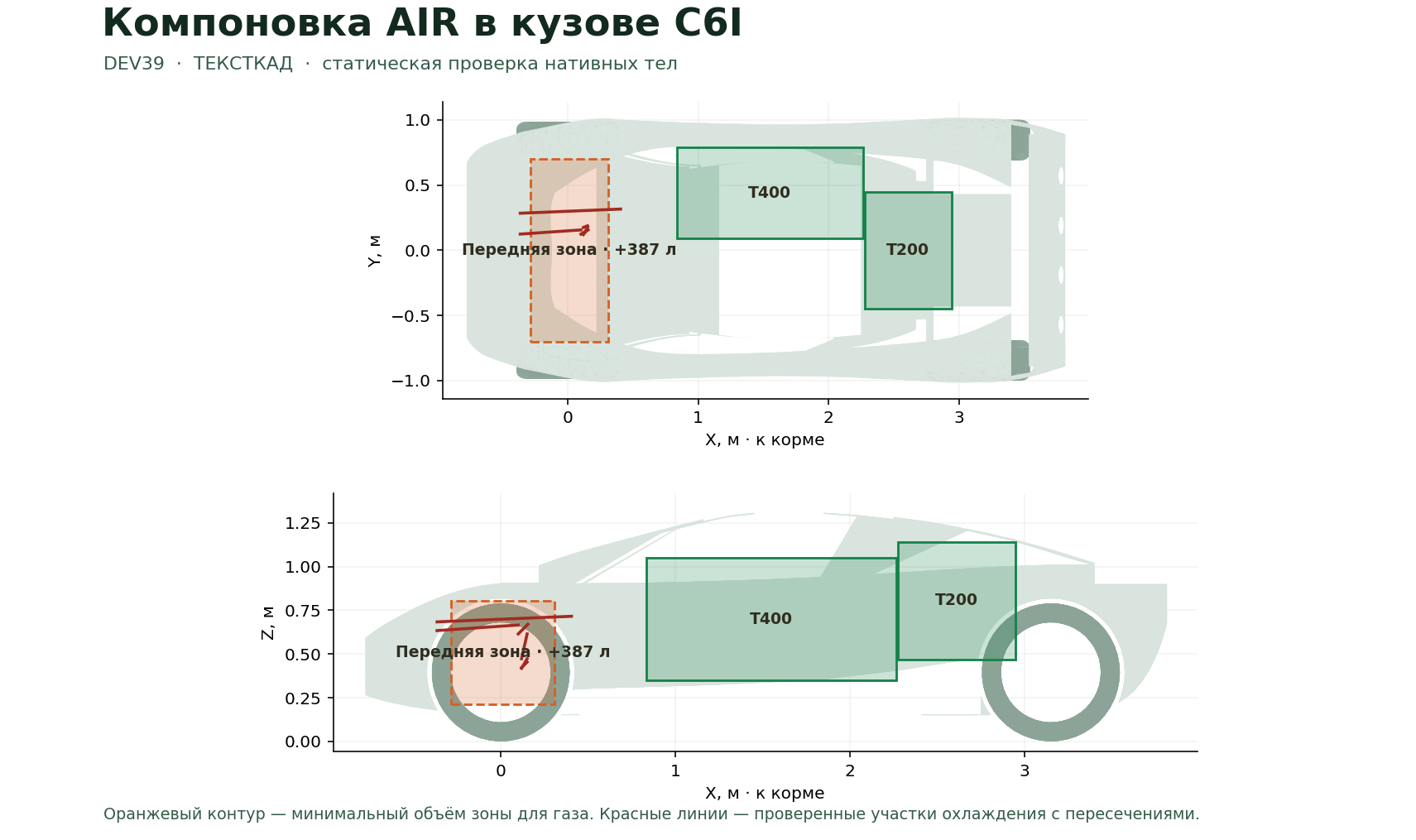
The economical case requires 913 L and consumes 413.39 kg of AIR. The forward case meets the dynamics criteria, including the tested sensitivity case. The additional 387 L intersects six cooling segments.

Economical run · Forward reserve · Packaging drawing

DEV40 · 387 L vessel and cooling routes

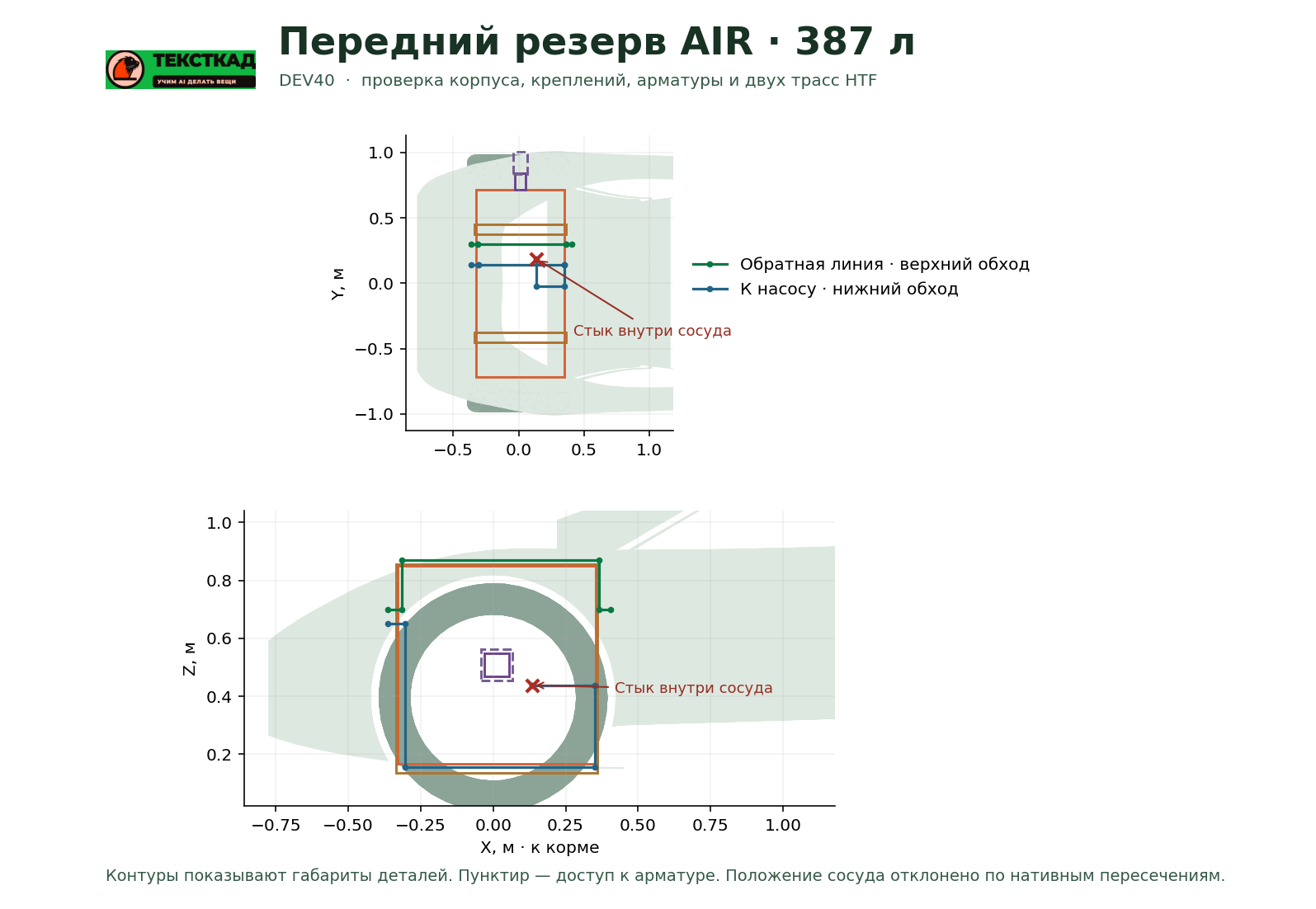
Both cooling routes were checked against the original ports. The transverse vessel interferes with the running gear. The 1 ms repeat meets four-wheel dwell, but yaw rate remains above tolerance at 1.12 s.

Nominal simulation · 1 ms repeat · Packaging drawing

DEV41 · Split AIR storage

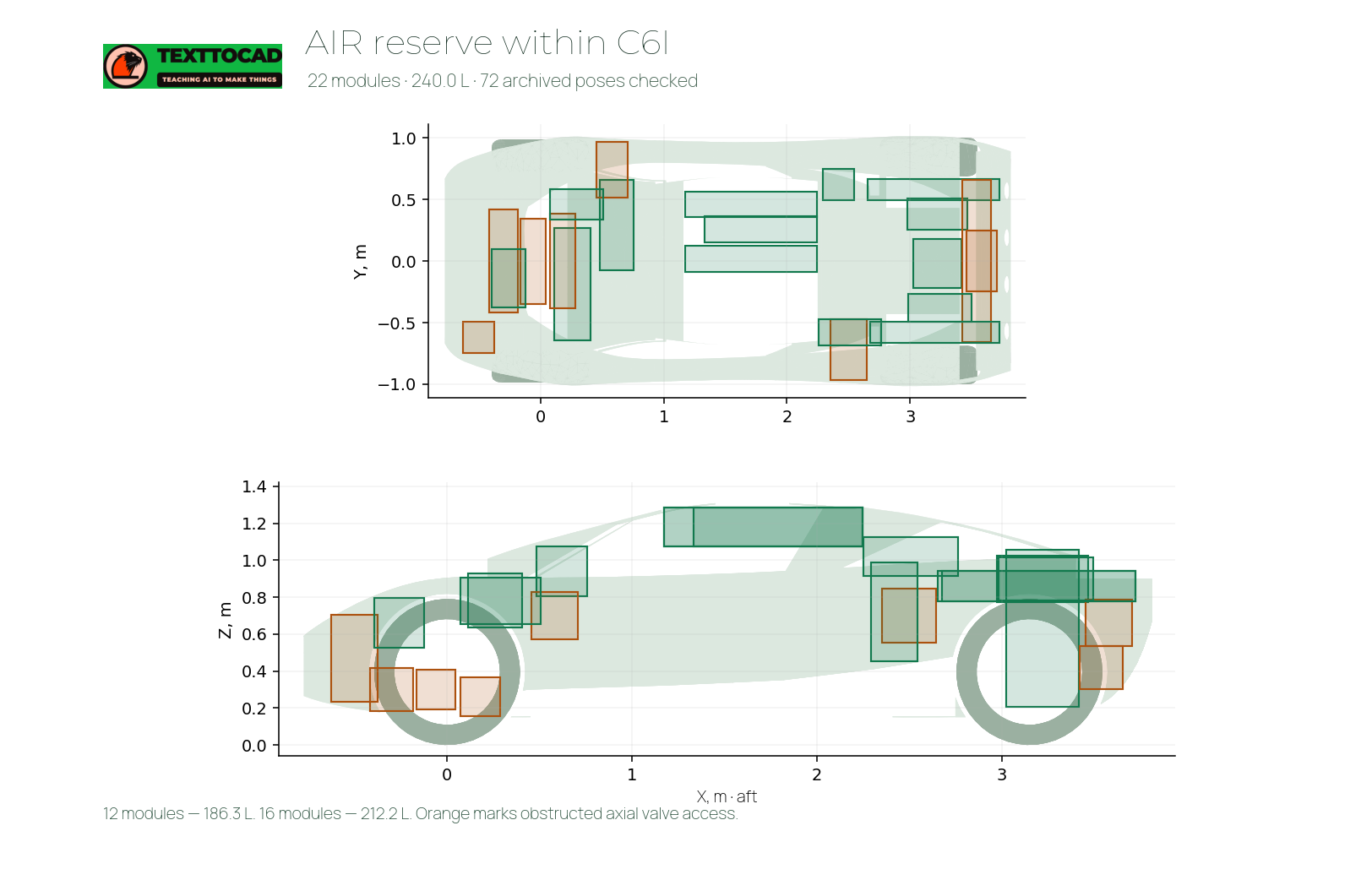
The C6I screen fits 22 modules totaling 236.7 L. The 387 L target remains short by 150.5 L. Nominal CAD gaps to the steering rack, suspension towers and HTF system are 32.5, 48.0 and 30.0 mm. The split package completes the numerical cycle under a 560 N/(kg/s) hypothesis. AIR feed performance awaits validation.

Base performance replay · 560 N/(kg/s) hypothesis · Packaging drawing

DEV42 · T400 charge and separate AIR circuits

The 240.0 L layout was checked in 72 archived poses. The archive T400 charge of 129.1 kg limits modelled dwell near hover to 0.69 s. The cycle passes under a 560/410 performance hypothesis. Eight access corridors and the new AIR performance map remain open.

T400 archive charge · Conditional pass · Layout · Archive maps

DEV43 · Valve access, header and T400

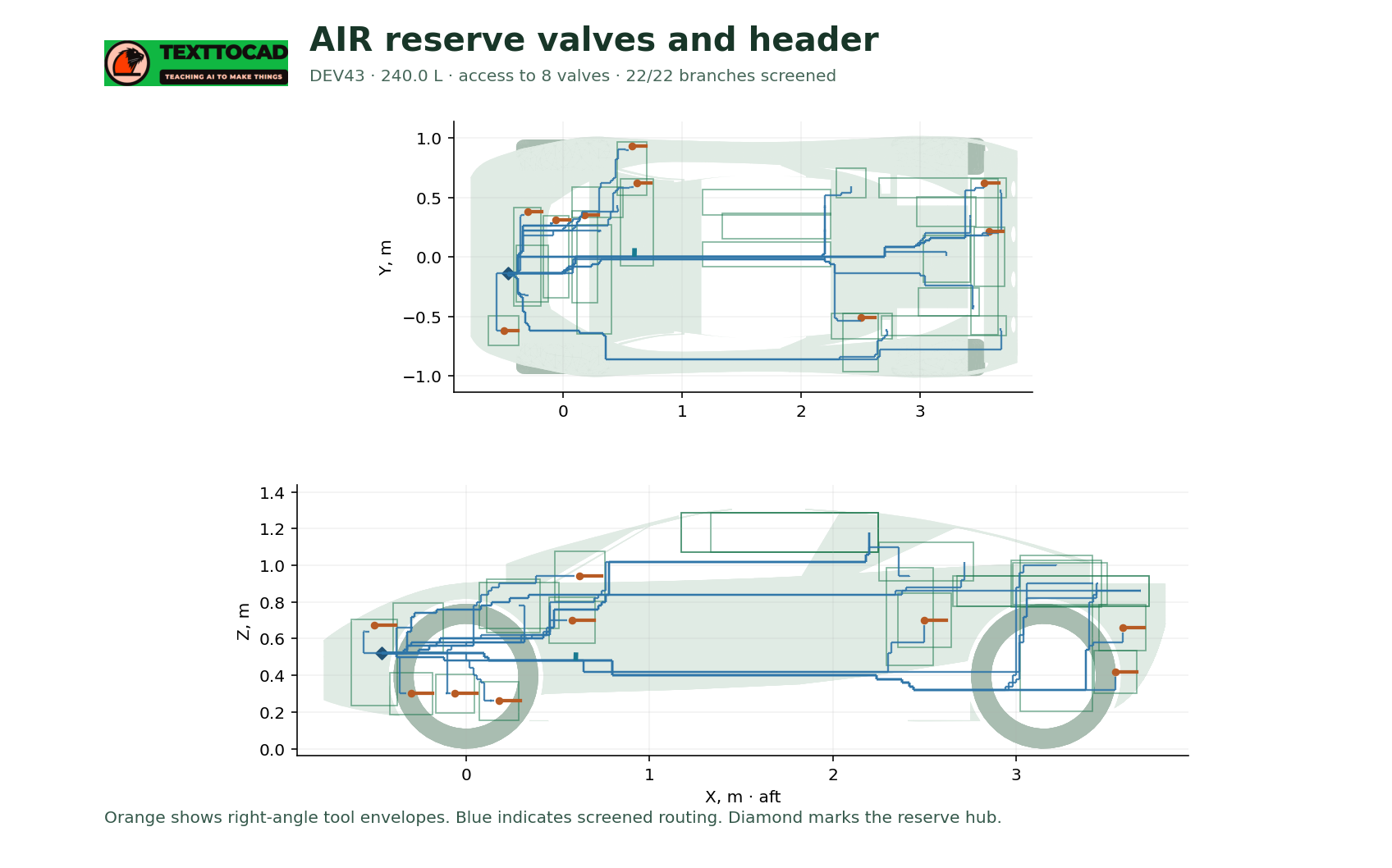
Geometry checks recovered access to the eight valves and AR03. 22/22 header branches cleared the archived pose checks. The archive T400 charge does not complete the hover cycle. The protected return was tested separately.

Archive charge · Protected return · Layout

DEV44 · Bounded AIR delivery

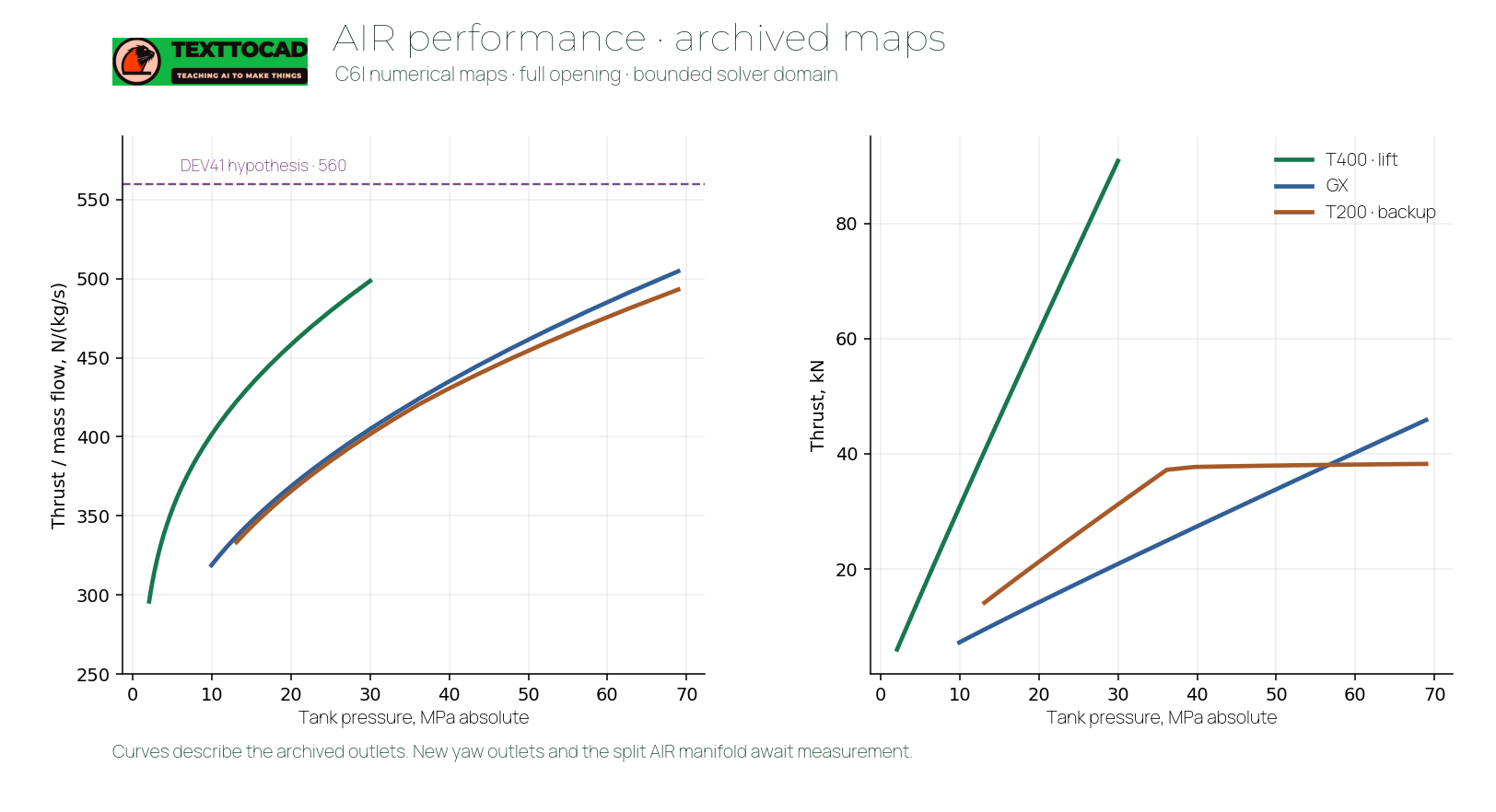
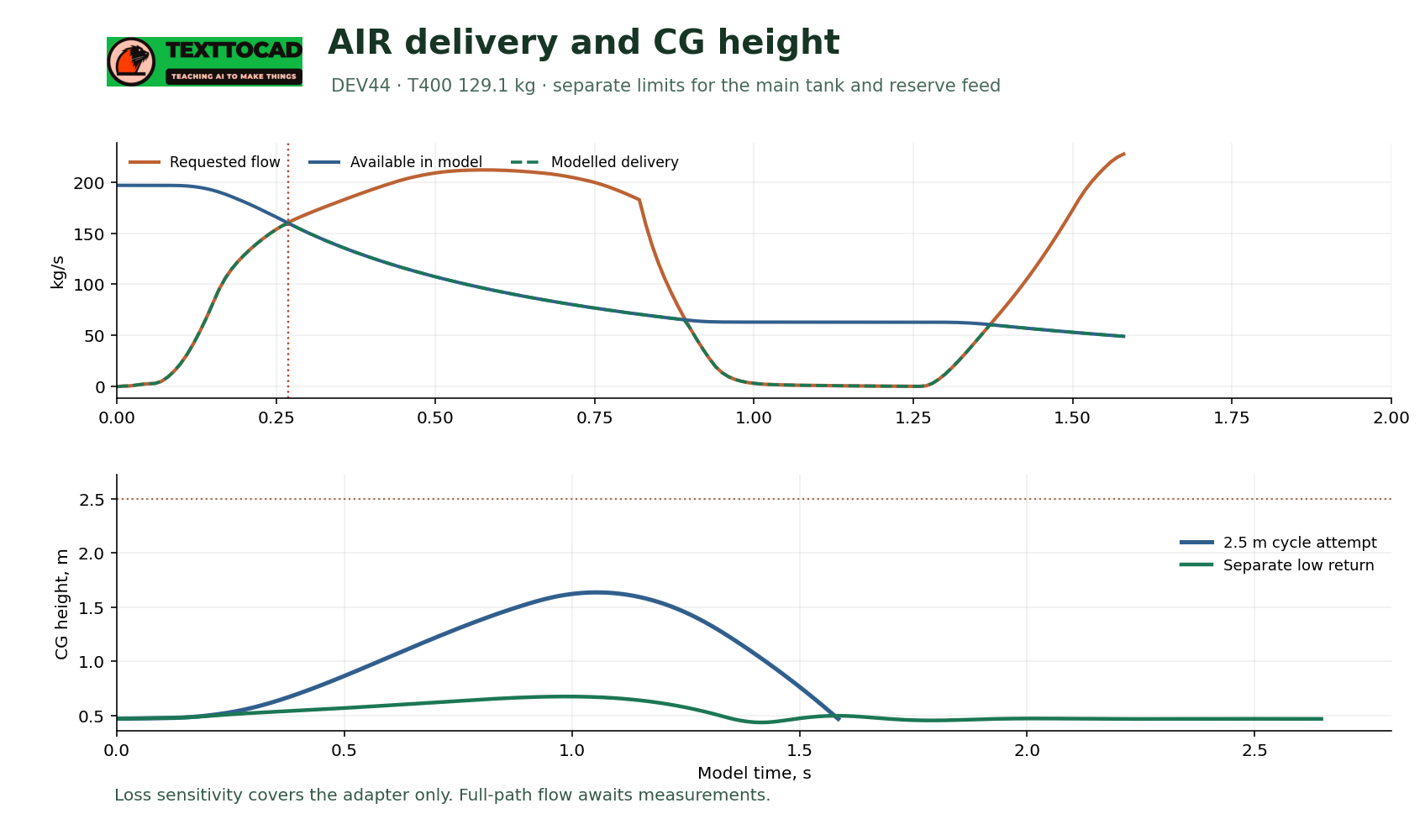
Twenty-two branches share a single outlet. The 16 mm proxy bore gives 14.5 kg/s at the initial state with adapter-only friction. The 2.5 m gate stays open. A separate low return was checked with bounded delivery.

Flow-limited replay · Low return · Delivery plot

Acceleration to 60 mph

Baseline
29.38 km/h at 0.810 s.
Nominal target
60 mph from rest within 0.810 s.
20% margin
60 mph within 0.648 s.
Result and verification
A coupled propulsion, traction and electrical-power run must reach the speed threshold.
Open episode →

CARBON ramp

Baseline
C6I loses support before the lip at 4.045 s. The DEV33 revision delays this to 4.491 s.
Nominal target
Cross the vertical section, depart at the upper lip and land facing the rollout direction. Test pitch recovery and the half-roll separately.
20% margin
At least 30 mm body clearance and a normal force of at least 2.16 vehicle weights in the specified zone.
Result and verification
Lip departure and landing remain open for both continuous runs.
Open episode →

Roll over five cars

Baseline
The first obstacle envelope is intersected at 3.450 s.
Nominal target
Complete a 360° barrel roll without a ramp, reaching 8.20 m CG height and 39.30 m range.
20% margin
At least 9.84 m CG height, 47.16 m range and 0.24 m clearance to each obstacle.
Result and verification
Continuous clearance to all five obstacles and landing after the full roll remain open.
Open episode →

Vertical encore by the tower

Baseline
The current replay reaches the 1 m/s rod limit at 1.066 s.
Nominal target
Vertical takeoff, 360° roll, at least 6.00 m CG height and landing beside the tower.
20% margin
At least 7.20 m CG height and at most 0.20 m of horizontal drift.
Result and verification
Verify tower clearance, inversion, resources remaining after the preceding stunt and supported dwell.
Open episode →

Hover and flat yaw turn

Baseline
C6I peaks at 1.380 m and turns up to 0.082°. The RR rod reaches 1.126 m/s after touchdown.
Nominal target
Hold 2.50±0.15 m for at least 1.80 s. Turn ±180° within 1.40 s. Four-wheel dwell ≥0.50 s and each rod ≤1 m/s.
20% margin
Hold 3.00±0.12 m for at least 2.16 s, turn within 1.12 s, maintain four supports for at least 0.60 s and keep rods ≤0.80 m/s.
Result and verification
The external package completes the functional cycle. Turn time remains open. With the fast command it reaches +68.49° at 1.12 s, with +116.47°/s still present.

Open episode →

Wall hold

Baseline
The FL_W0/W1 seal rig predicts 1.419 kN at a 5 mm gap. Whole-perimeter measurements are pending.
Nominal target
Hold at 90° for at least 1.00 s with at most 25 mm longitudinal drift, then return to the pad.
20% margin
At least 1.20 s dwell and no more than 20 mm drift.
Result and verification
Measure leakage, synchronisation of all 128 segments and four zone reactions. Ceiling hold requires a separate run.
Open episode →

Active aerodynamics

Baseline
The CAD contains a wing surface. Paired actuator positions and aerodynamic loads are pending.
Nominal target
Test a steady turn both ways above 2 g for at least 1.00 s, with flap travel up to 80°.
20% margin
At least 2.40 g for 1.20 s with the same 80° travel limit.
Result and verification
Compare active and fixed aero at the same radius, surface, mass and tyre condition.
Open episode →