V1 · panel_fit
- Frame time
- —
- Forward travel
- —
- Clearance above the plane
- —
- Pitch
- —
- Roll
- —
- First contact
- Contact
- Contact point downward speed

Argon R06 · V1 / V2
Argon R06 · V1 and V2
R06 geometry with historical R3 dynamics assumptions. Command speed is 60 km/h, with lift-off from a level plane. R06 mass properties and thrust characteristics remain unverified.
Compare V2 landings · V1 stabilisation at 60 km/h · V1 landing from the original height
V1 touches down on its right rear tyre. Pitch , front splitter clearance .
The cameras are linked. Full-route view uses the same scale for both variants.
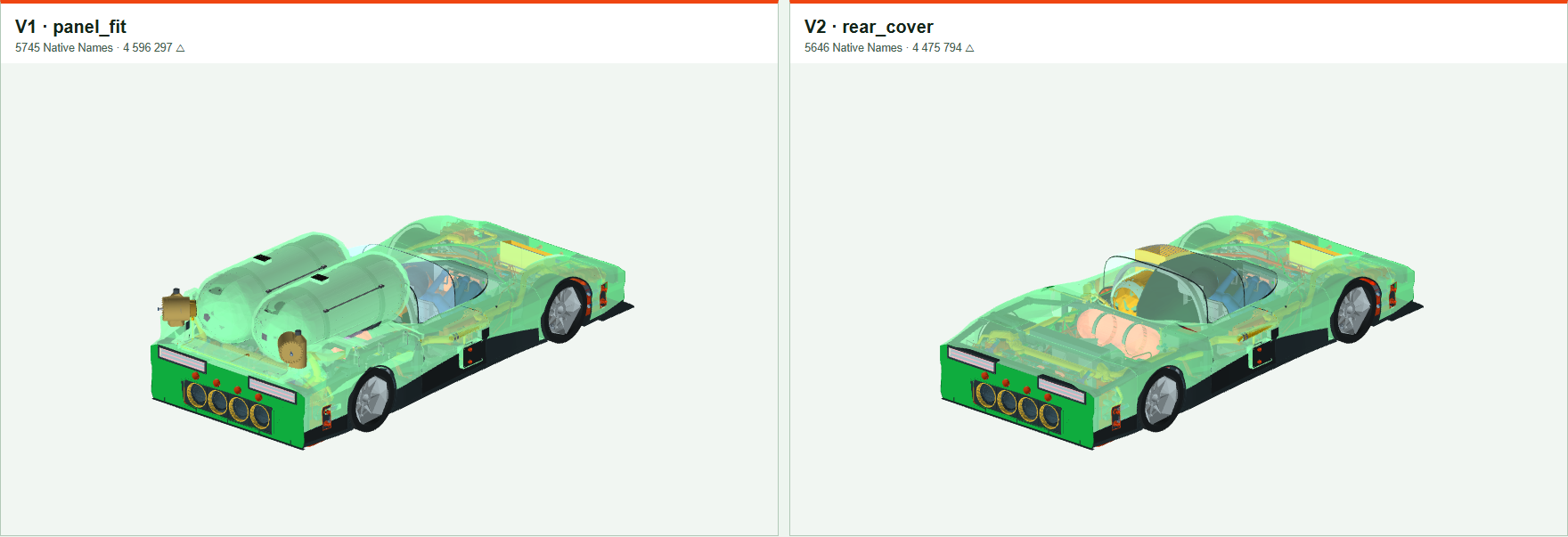
Time is aligned at lift-off for both variants. Each view and its telemetry freeze at its first contact.
Calculated coordinates on the shared clock from lift-off. Dashes after V2 contact show the difference from its held contact frame.
The solid line shows the selected variant and the dashed line the other one. Click the chart to seek.
Illustrative attitude model. Commands are percentages of a nominal range. Lower outlet locations come from R06 CAD. Side jets are schematic.
Open positioningOpen the R11 route and readings for 28 outlets
WebGL2 is needed for the jet view. Angles and commands remain available in the table.
| Channel | Command | Angle |
|---|---|---|
The original high hop exhausts usable air before braking. The tuned run shortens the climb, with underbody A/B nozzles slowing the descent and side LOW/HIGH nozzles holding the heading. The front left tyre touches first.
| Parameter | Original hop | Tuned low hop |
|---|
R06 geometry with the assumed R3 air network. Entry speed and initial air are fixed. The model ends at first contact. Suspension loads and rollout require a separate calculation.
Drag to orbit and scroll to zoom. You can also use the arrow keys to rotate the camera.
The trajectory starts at lift-off and ends at first contact. On a level surface without a lift command there is no airborne phase.
The stored trace includes positions and quaternions at 5 ms intervals and the exact first-contact endpoint. Intermediate frames are interpolated for display.
The player uses a reduced display mesh. Use the native FCStd files for measurements.
V1 shows tuned landing at the original height. V2 shows tuned landing after a low hop. Both replays end at first tyre contact.
D02 reconciles 36 lift assembly parts. Full-vehicle mass, centre of mass and inertia remain open. D02 did not rerun landing because verified thrust, valve response and concurrent supply data were insufficient.