CF700
——
The gimbal aims thrust. Fuel · JP-4.

Computed flight of the NASA 952 reconstruction from ground start to rest on its supports.
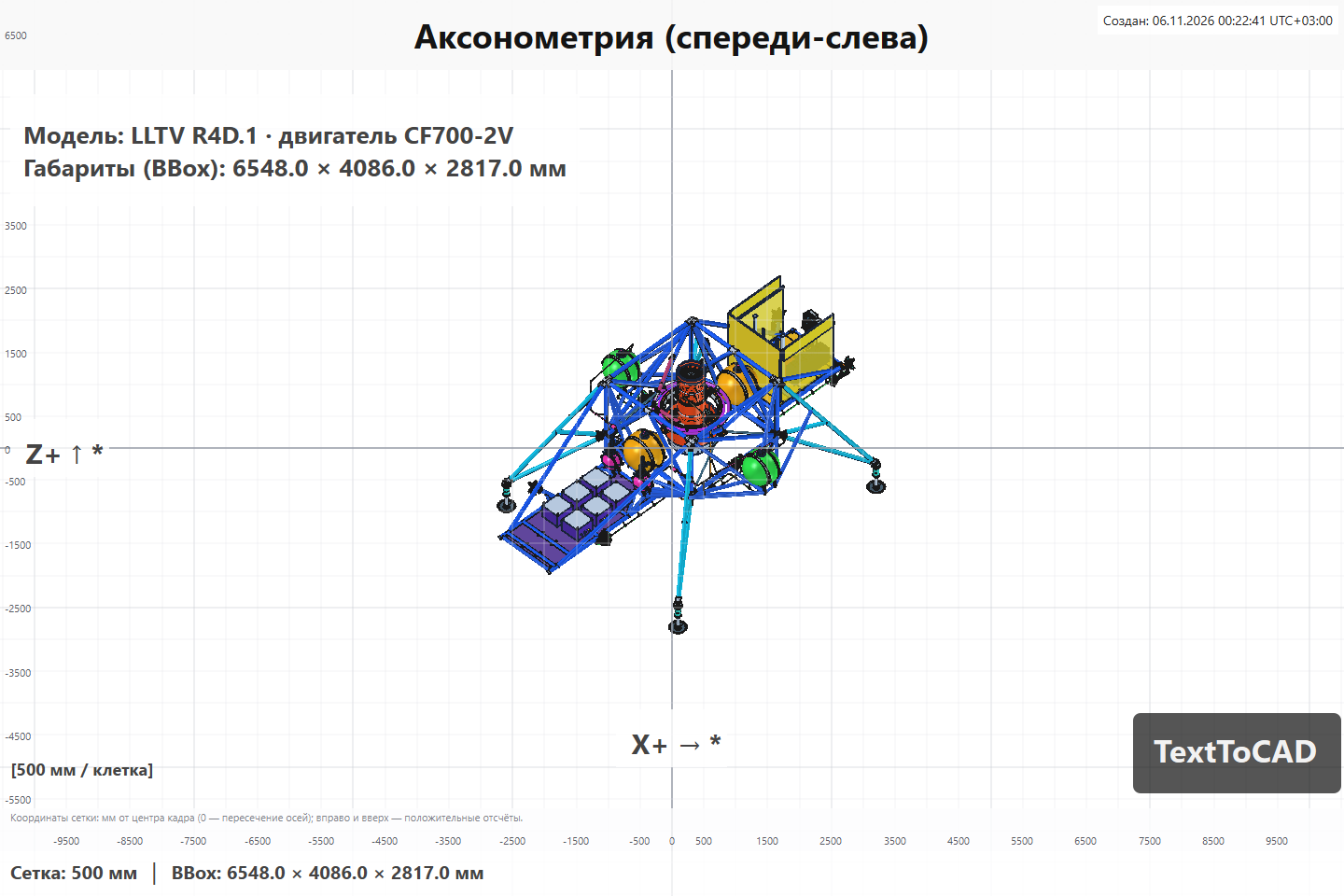
Static FreeCAD view. The timeline and plot still work.
Drag to orbit. Use the wheel or plus and minus keys to zoom. Space toggles playback and the arrow keys step through the trace.
The flight, cutaway, JP-4 and H₂O₂ readings share one timeline.
—
The gimbal aims thrust. Fuel · JP-4.
—
H₂O₂ · —
Sum of thrust magnitudes —
Force · north / east / up —
Moment · roll / pitch / yaw —
H₂O₂ · —
Select a phase to jump to its start. The table reports use during each interval and remaining mass at its end.
Narrated walkthrough · RU · Phase-by-phase resource proof · PDF · RU · Sources and calculation method
Speeds are cruise targets. Range and time are shown as normal / go-around. Time runs from liftoff to touchdown. Pairs are JP / H₂O₂ in kg. The required reserve is 120% of use through shutdown plus 5% of the full load.
| Air / wind / ground, m/s | Range, m | Airborne, s | At approach | Required for go-around and landing | Excess over go-around reserve | 3D replay |
|---|
Phase use (CSV) · Headwind report · Russian-narrated video
Phase use (CSV) · Crosswind and circuit report · Russian-narrated video
The native mesh is centred on the current centre of mass, rotated by the sampled quaternion, and translated to the computed position. Position is interpolated linearly, attitude spherically. Contact is sampled discretely.
CoM height is measured from the support datum. Negative clearance represents compression in the contact model. The trajectory and telemetry belong to the R4D.1 numerical reconstruction. The showcase contains the source and evidence package.