 Report · C.400 P.2 / Roadster Rocket
RR-H1 coupled simulation
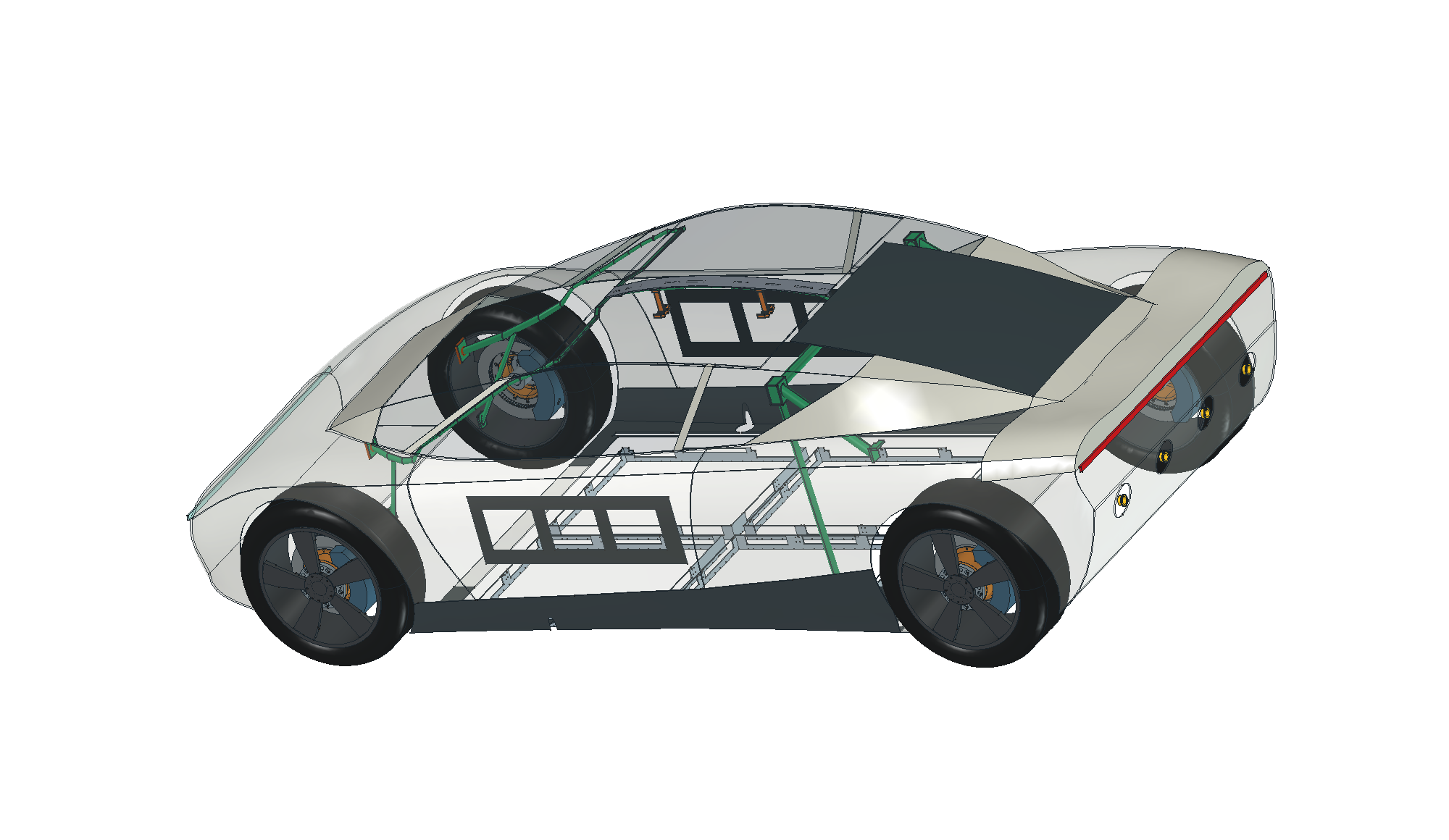
The coupled RR-H1 reaches first contact. The finer run touches down at 1.44 m/s downward, with -2.60° roll and 0.63° pitch. It retains 207.91 kg at solver termination. Rest and its reserve require a run that passes the contact gates.
| Quantity | Coarse step | Finer step |
|---|---|---|
| Gas step, ms | 12 | 6 |
| Airborne time, s | 0.539 | 0.488 |
| Horizontal displacement to contact, m | 2.70 | 2.44 |
| First wheel | RL | RR |
| Downward contact speed, m/s | 1.63 | 1.44 |
| Roll at contact, ° | 0.76 | -2.60 |
| Pitch at contact, ° | 1.49 | 0.63 |
| Air at solver end, kg | 206.73 | 207.91 |
| 10% reserve, kg | 23.53 | 23.53 |
| Termination | Damper rod speed exceeded the domain | Damper rod speed exceeded the domain |
Roadster short flight RR-H1
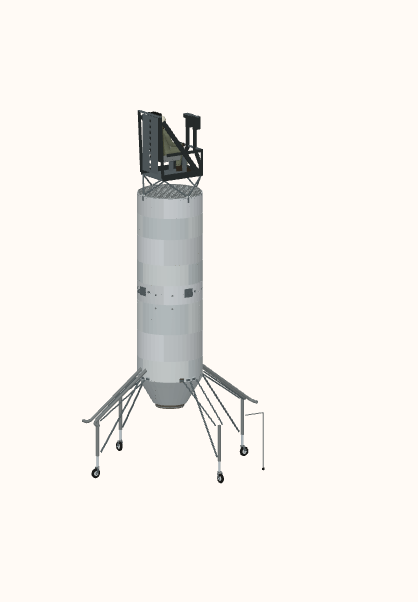
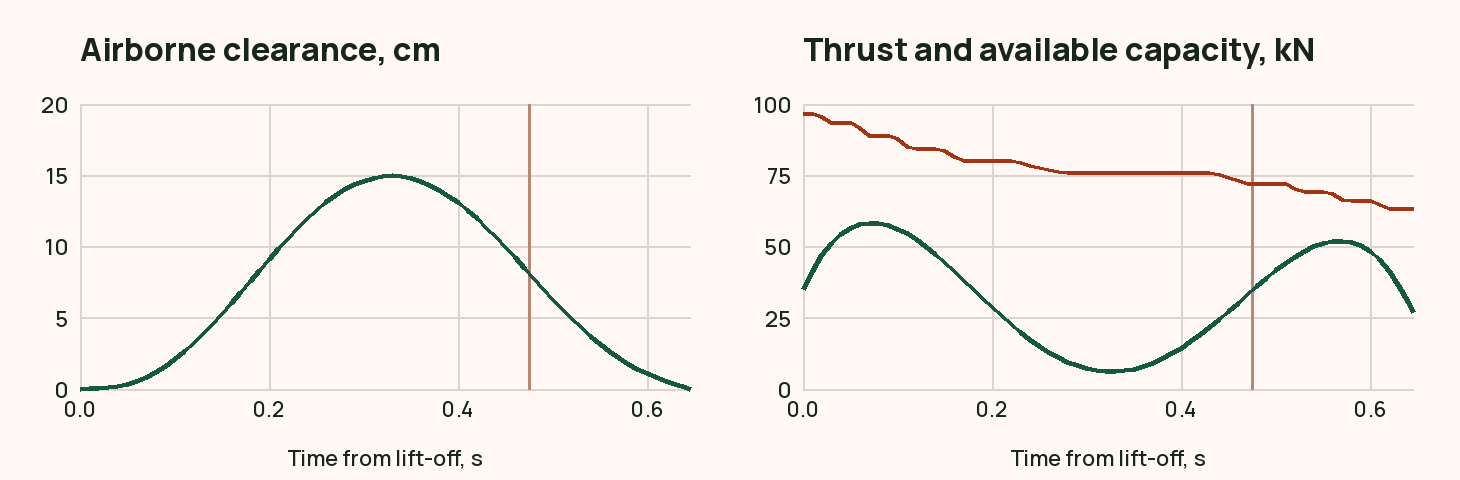
The level-landing model gives 0.645 s airborne, 3.22 m to touchdown and about 15 cm peak clearance. Displacement to rest is 9.53 m. Remaining air is 183.97 kg nominal and 171.00 kg adverse against a 23.53 kg reserve. Roll, pitch and individual support dynamics remain outside the model.
Animation · Calculation and assumptions
Roadster landing reserve
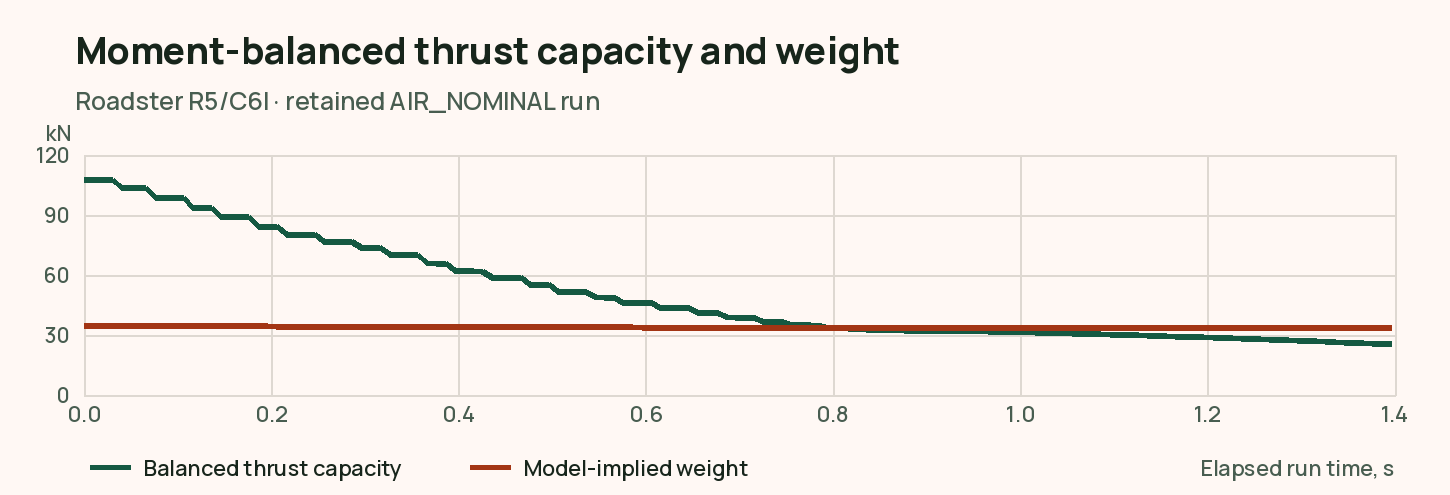
The Roadster R5/C6I model starts with 235.27 kg of dry air and protects 23.53 kg by mass. At a 54 km/h speed cap, the conditional impulse bound is 2.98 s and 44.7 m airborne. It allows 54 km/h at release and assumes equal endpoint vertical velocities.
| Scenario | Airborne | Displacement | Fluid at rest |
|---|---|---|---|
| R6E5 P1 4100 mm | 415.03 s | 4.511 km to rest | 65.06 kg kerosene |
| R6E5 P1 5250 mm | 415.03 s | 4.511 km to rest | 65.07 kg kerosene |
| Roadster R5/C6I | ≤2.98 s impulse bound | ≤44.7 m airborne | Landing result unknown |
AIR_NOMINAL records 1.33 s and 1.05 m from release to its last sample. The system contains 134.68 kg at solver stop. Last-sample moment-balanced thrust is 25.52 kN against 33.80 kN weight. Post-landing inventory and displacement to rest remain unknown.
Full-fuel mission P1
With 500 kg of fuel, both assemblies cover 4.51 km and spend 6 min 55 s airborne. Straight-leg speed is 54 km/h. Braking starts with 148 kg on board. About 83 kg is used from braking to rest, leaving about 65 kg. The scenario holds 50 kg of usable reserve and treats 10 kg as unusable.
| Quantity | 4100 mm | 5250 mm |
|---|---|---|
| Airborne, s | 415.03 | 415.03 |
| Displacement at rest, km | 4.511 | 4.511 |
| Gross fuel at rest, kg | 65.06 | 65.07 |
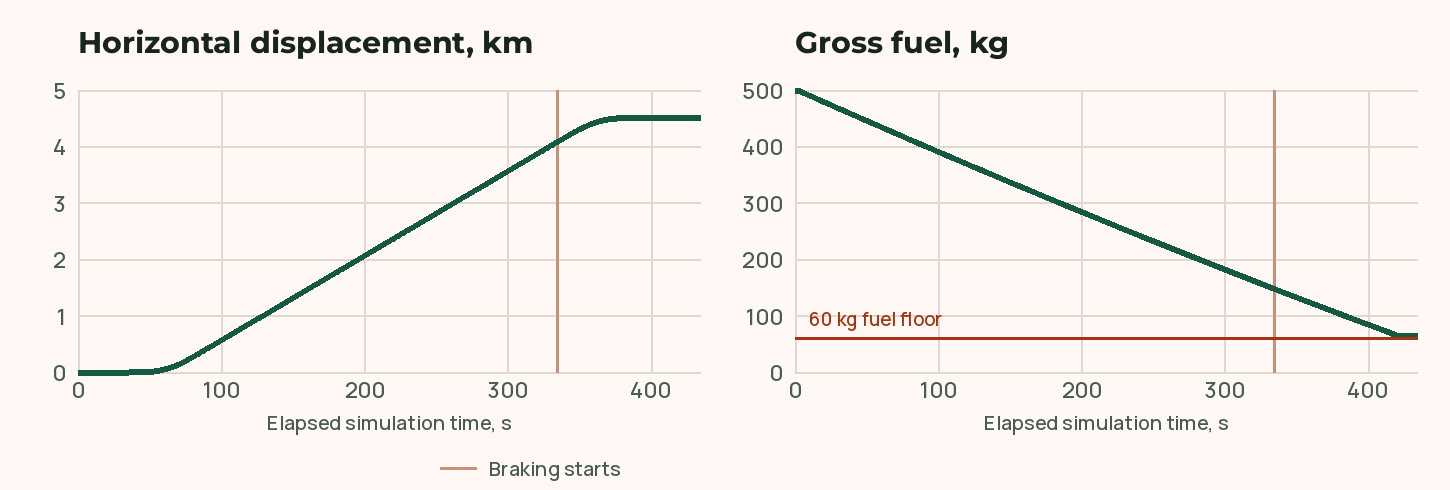
The higher fuel-flow and drag run gives 3.88 km and 6 min 13 s with reserve retained. Physical range depends on fuel flow, drag and the location of the drag centre.
Range and fuel reserve describe the C.400 P.2 simulation. Roadster evidence covers Tesla clip-clock intervals and separate DEV25 trials. A comparable range mission and its fuel budget remain open.
Player for both assemblies · MP4 · Assumptions · Results and checks
10× playback. The 43.4 s video covers 7 min 14 s of simulated time and shows both assemblies together.
R6E5 virtual flight
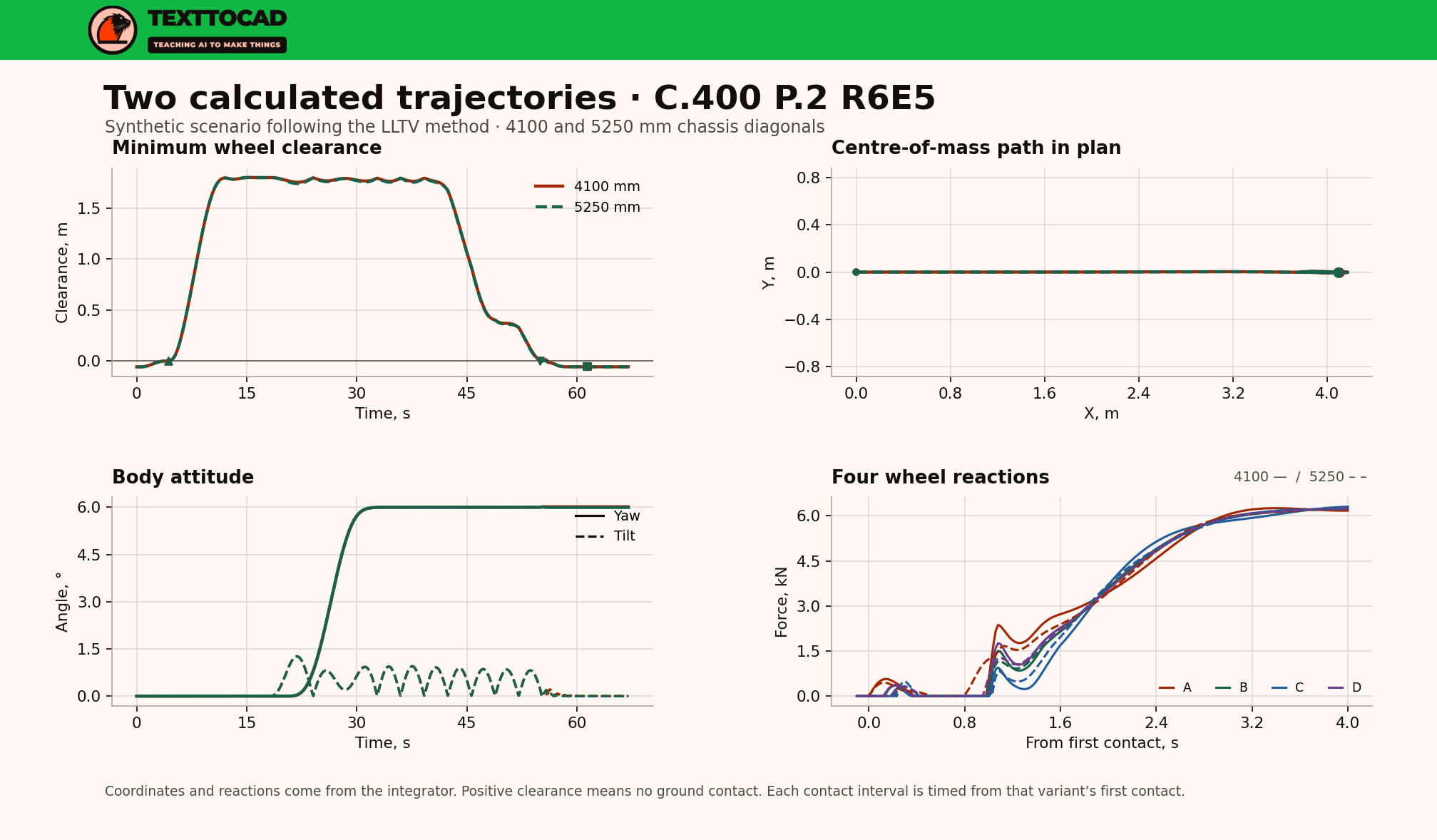
P0 runs from static supports to rest after touchdown. Compare phase definitions and support conditions. The historical sortie lasted 255 s. Tesla clips supply clip-clock bounds.
| Diagonal, mm | 4100 | 5250 |
|---|---|---|
| Airborne, s | 50.690 | 50.636 |
| Clearance, m | 1.801 | 1.801 |
| Transfer, m | 4.102 | 4.093 |
| COM descent speed at touch, m/s | 0.077 | 0.080 |
| Rest time, s | 61.440 | 61.385 |
Steps of 2.5 and 5 ms at a 20 ms controller period. 2 of 6 sensitivity cases meet the numerical gates.
Mission playback and wheel reactions · Assumptions register · Plots
Configurations and scope
Auguste Morel piloted the C.400 P.2 on its first free flight at Melun-Villaroche on 14 May 1957. The rig used a vertically installed Atar 101 D.V. AAMS lists about seven to eight minutes of endurance. The narrative lists 680 L for a full fill and the table lists 500 kg of fuel. Fuel use during that flight is open.
| Record | What it establishes |
|---|---|
| C.400 P.2 / historical airframe | The museum record describes a wingless test vehicle with gas jet control. AAMS records the piloted flight and gives its duration. |
| C.400 P.2 / R6E5 | Native 4,100 and 5,250 mm chassis assemblies establish reconstruction geometry, including the C3-to-collector duct. |
| Tesla / 15 October 2026 reveal | Tesla’s quarterly update establishes the reveal date. The official selected clips establish observable events in each edit. |
| Roadster / R07 and R5/C6I | R07 is the local layout and costing CAD. R5/C6I and DEV25 are separate digital trials with their own criteria. |
Forces on the support and in the air
| Principle | Engineering result and verification |
|---|---|
| C.400 P.2 · vertical thrust | Atar 101 D.V. carries weight after release. Gas jet control uses compressor bleed. Compare vertical force and independent control moments by axis. |
| Roadster · ramp contact | Electric drive provides the run-up. Tesla shows fan-assisted downforce and wheel contact on the ramp. Check contact phase, normal reaction and the release event. |
| Roadster · after release | Tesla attributes attitude changes to gas impulses. Isolating their contribution would need time-aligned masses, forces, moments and footage. The video markers establish events. |
AAMS historical diagram · Tesla Roadster event, The Ramp and Kickflip chapters · Tesla Roadster Event
AAMS, pp. 21–22 and 36 · Musée de l’Air et de l’Espace · Tesla Q3 2026, p. 4
Motion phases and video markers
Use one visible shot per clip. Four presentation timestamps mark the last selected supported frame, the first visible gap, the last certainly airborne frame and confirmed rolling. The lower bound is t₃ − t₂ and the upper bound is t₄ − t₁. Rolling bounds contact when the instant is obscured.
| Episode | Observation and value |
|---|---|
| C.400 P.2 | Vertical takeoff, controlled motion and return in the test flight. 255 s is the reported sortie duration. Separate takeoff, manoeuvre and first-contact times remain open. |
| Ramp 2.503–6.006 s PTS | The ramp is part of the entry condition. After release, footage shows an attitude change and later rolling. |
| Kickflip 2.878–5.506 s PTS | Inversion is visible during the crossing. The angle, axis and exact first contact need separate measurement. |
| Encore 2.544–5.756 s PTS | Release and attitude change are visible. Glare and the cloud limit observation of the first contact. |
RR-PTS · Tesla primary clips · preserved LLTV package frame markers
Tesla clip-clock bounds
Intervals in seconds on the edited clip clock. Physical airborne duration remains open.
Clip-clock interval
- Before release
- First visible gap
- Last airborne frame
- Confirmed rolling
Forces geometry and digital checks
Atar reference thrust of 28.439 kN and weight of 25.497 kN at 2,600 kg give a static ratio of 1.115. The 2,640 kg table value gives about 1.098. A fully resolved motion model needs time histories for force, control, mass, inertia, centre of mass and support contact. A closed-loop R6E5 P0 mission was simulated. Time histories for the historical flight remain open.
| Check | Verified result |
|---|---|
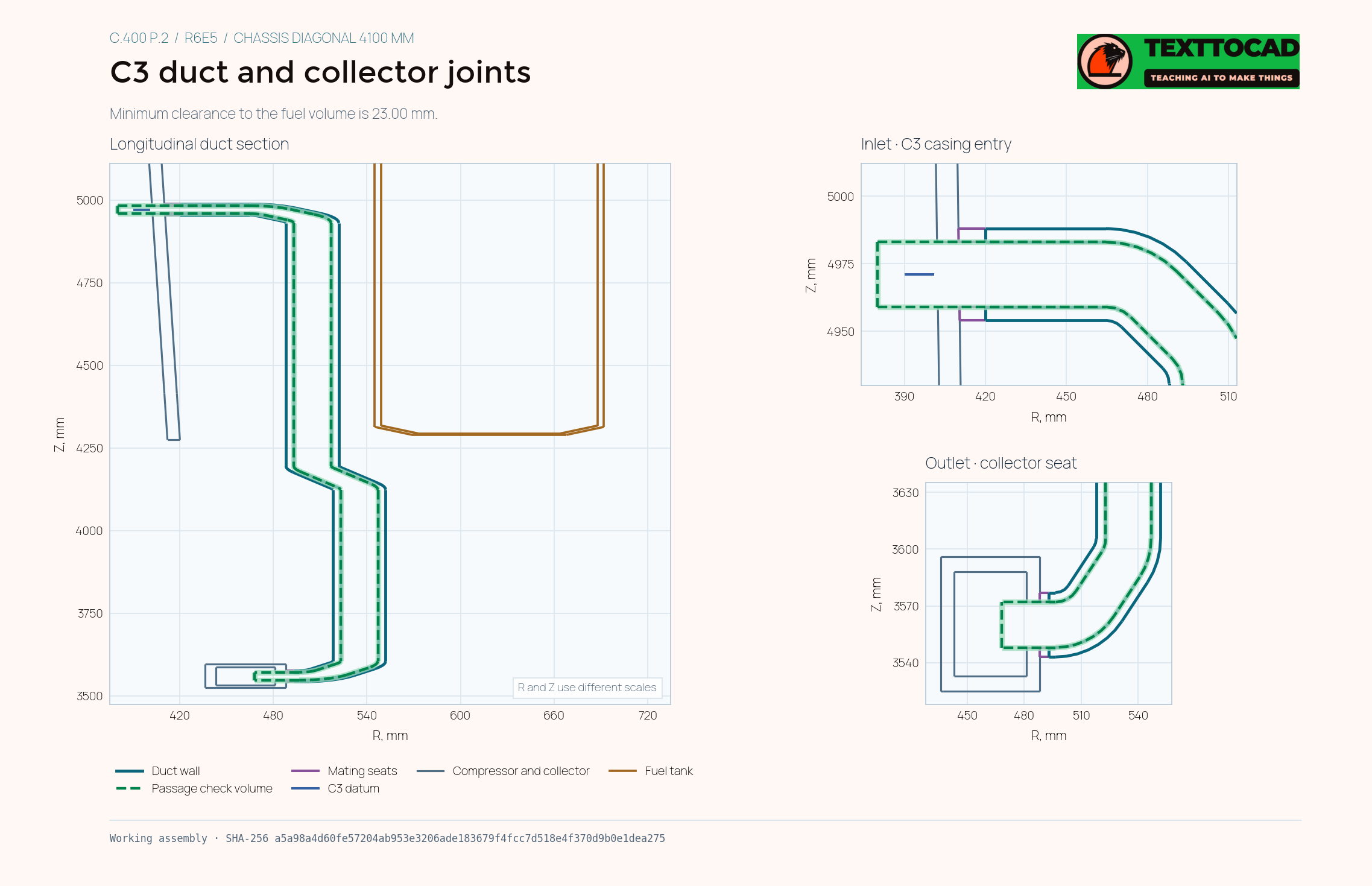
| R6E5 4100 and 5250 | The C3-to-collector passage was checked against native BRep. Each assembly has 14 sections, an open area of 452.389 mm² and 23 mm clearance to the fuel volume in the saved pose. |
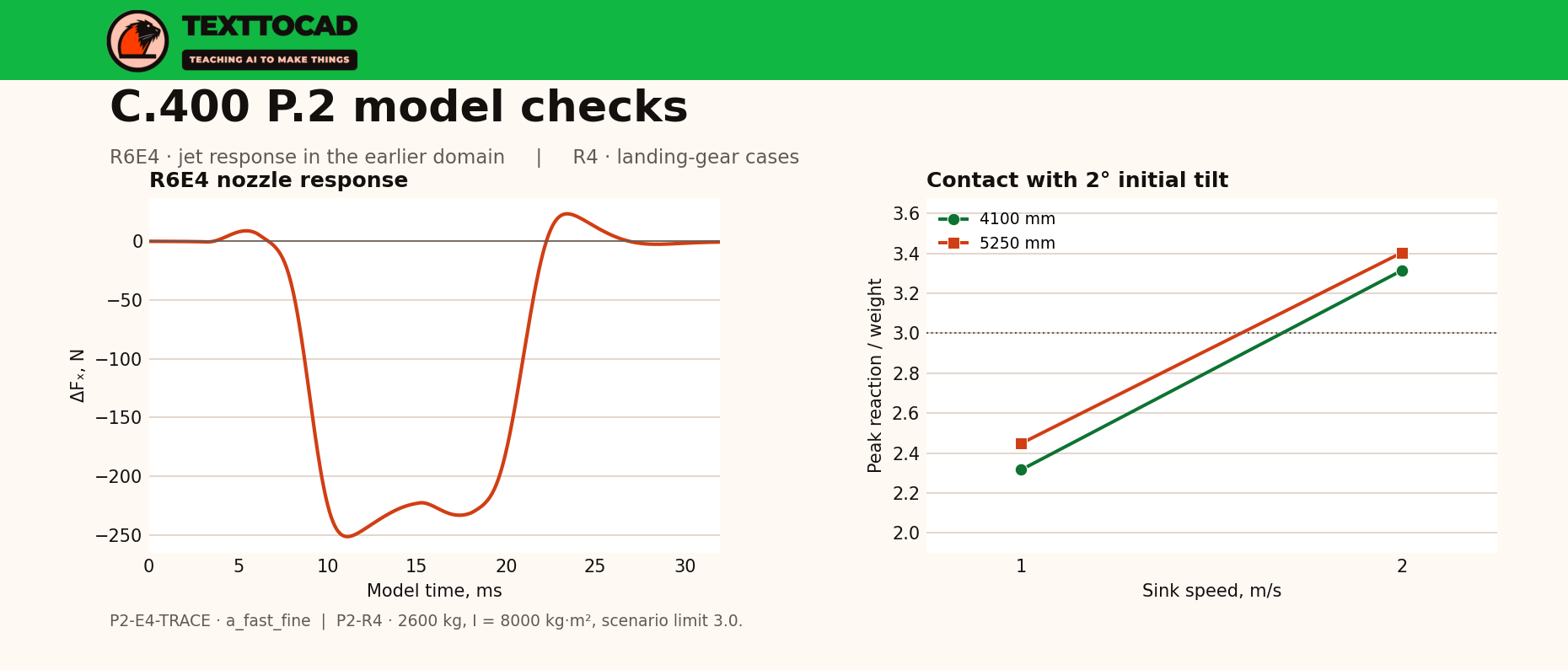
| R6E1 and R6E4 | The steady cycle and CFD are tied to their input assumptions. The R6E4 response is for the earlier numerical domain. It does not measure the hardware response after R6E5. |
| Roadster R5/C6I DEV25 | The principal 5 m series accepted 0 of 4 cases. In a separate 2 m attempt, centre-of-mass rise was 2.268 m and first contact occurred at 1.770 s. The trace stopped 29.5 ms after contact and lacks the 0.5 s dwell. |
Interactive 3D · Current assembly sections
P2-R6E5 · P2-R6E4 · RR-DEV25 · reproducible static and PTS checks
Resources and programme economics
A comparable scenario aligns fleet size, attempts, time horizon, currency, tax basis and work scope. Track initial loading, event consumption and refill separately. Published C.400 P.2 fuel figures belong in the configuration record. Actual usage for the first sortie remains open.
| Metric | Calculation scope |
|---|---|
| Programme cost | Development + fleet production + fixed costs + attempt costs. Missing prices and unconfirmed rates remain editable inputs. |
| Attempt and accepted case | Attempt cost divides programme cost by attempts. Expected accepted-case cost uses a scenario success fraction. A zero fraction leaves the result blank. |
| Airborne second | A result is available when the chosen phase has a known physical duration. Tesla clips supply PTS bounds. The cost output remains blank for an unknown physical duration. |
| Dated estimates | The 14 Nov 2026 C.400 Spec R5 covers the priced portion of manufacture with key quotes open. The 21 Nov 2026 R07 estimate is a local commercial scenario for ten units. Each estimate retains its own scope. |
Figures with different scopes. Spec R5 for the 4,100 mm variant prices the assessed manufacturing portion at RUB 2,828,930 in Russia and USD 118,966 in Texas. In the local ten-unit R07 commercial scenario the target unit prices including tax are RUB 817,887,019, USD 11,748,623 and EUR 11,158,009 for the respective markets.
Spec R5 · R07 · formula workbook and calculator use common inputs
Reproduction and acceptance
The LLTV method supplies the sequence from configuration records to publication evidence. For each revision, pin inputs and hashes, log the visible events and separate calculation conditions. Repeat the PTS and static reference checks. Regenerate dependent views and narration when an input changes.
| Material | Verification |
|---|---|
| Evidence | Read evidence/comparison.json and evidence/sources.csv. Check historical documents, native geometry, footage and simulation in their respective scope. Each numerical statement has a source locator. |
| Calculator and workbook | Change fleet size and check allocated development. An unknown physical duration leaves the price per airborne second blank. Rates and currencies keep their date. |
| Interactive 3D | Select the assembly and a system, toggle isolation and explosion, rotate and reset. Exploded offsets explain assembly content. Native geometry is tied to a file hash. |
| Publication package | HTML, PDF and DOCX point to the same records. The overview and engineering walkthrough have their own narration and subtitles. Check deliverables against the package manifest. |
- AAMS, C.400 P.2 / 21–22
- Musée de l’Air et de l’Espace · C.400 P.2
- Tesla Q3 2026 Update / 4
- Tesla Roadster · Rocket
- NASA SP-2004-4535 · LLTV / LLRV
Method source: Comparative Materials for LLTV and Roadster Rocket, Analyse the LLTV Project chat.