
LLTV R4D.1 passport
Dimensions, mass, flight scenarios, servicing and cost estimates for the NASA 952 reconstruction.
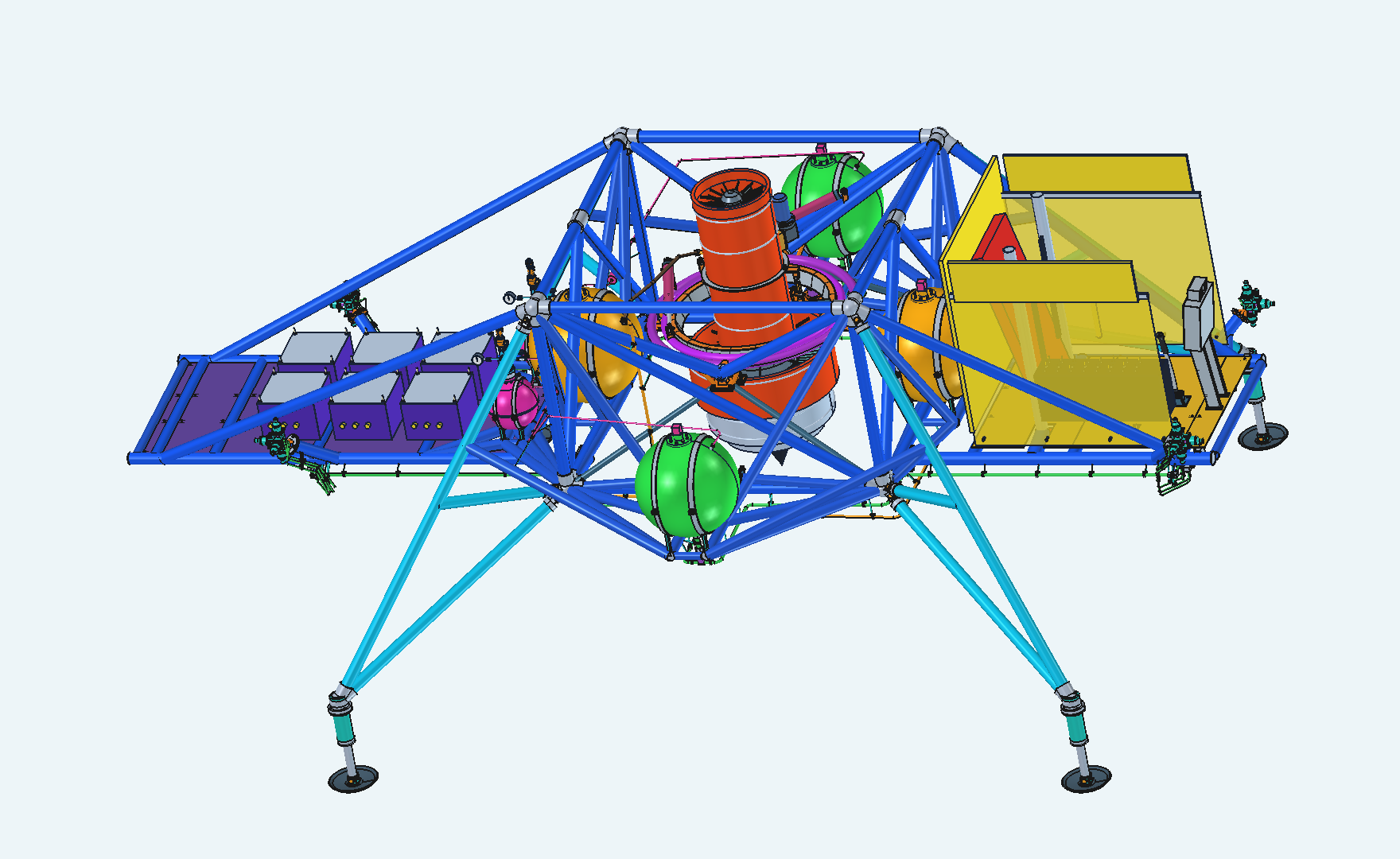
Technical and economic parameters
Rows 56
No matching parameters
| Parameter | Value | Evidence type | Conditions and source |
|---|---|---|---|
| Dimensions and crew | |||
| Configuration | LLTV NASA 952 / R4D.1 | CAD / ledger | Saved neutral TextToCAD reconstruction of the lunar landing trainer.CAD |
| Length × width × height | 6.548 × 4.086 × 2.817 m | CAD / ledger | World-space envelope of visible BRep solids, including landing gear.CAD |
| Landing gear wheelbase × track | 4.4 × 3.8 m | CAD / ledger | Between pad centres; four pads.MASS |
| Landing pads | 4 | CAD / ledger | Contact points come from native geometry.MASS |
| Crew / model pilot mass | 1 / 79 kg | CAD / ledger | One seat. The pilot mass is a model assumption.MASS |
| Mass, balance and inertia | |||
| Empty vehicle | 1 173.771 kg | CAD / ledger | Without pilot or working tank contents; fixed equipment per R4D.1.MASS |
| Vehicle with helium only | 1 174.541 kg | Derived | Empty vehicle plus He, without pilot, JP‑4 or liquid H₂O₂.MASS FLUID |
| With pilot, without working fluids | 1 252.771 kg | CAD / ledger | Dry starting configuration for the simulations.MASS |
| Fully loaded without pilot | 1 689.071 kg | Derived | 95% of liquid tank volume and the full He charge.MASS |
| With pilot, 50% usable liquid load | 1 510.806 kg | CAD / ledger | 47.5% of geometric tank volume; full modelled He charge.MASS |
| Full start mass with pilot | 1 768.071 kg | CAD / ledger | 95% of geometric liquid tank volume and full modelled He. Maximum takeoff weight remains unverified.MASS |
| Fully loaded centre of mass X / Y / Z | 2.72 / −1.21 / 256.04 mm | CAD / ledger | Relative to CAD origin: forward, right, down.MASS |
| Fully loaded principal moments of inertia | 1 678.4 / 3 354.9 / 4 357.7 kg·m² | CAD / ledger | About the centre of mass.MASS |
| CF700 mass in assembly | 285 kg | CAD / ledger | Assigned engine mass; included in empty mass.MASS |
| Tanks, liquid peroxide and gas | |||
| JP‑4 tanks · internal capacity | 2 × 146.46 L = 292.93 L | CAD / ledger | Two CF700 fuel tanks, geometric internal capacity.FLUID |
| JP‑4 · full usable load | 278.28 L / 222.63 kg | CAD / ledger | 95% of volume. Model density 0.8 kg/L.FLUID |
| Liquid hydrogen peroxide H₂O₂ tanks · capacity | 2 × 109.74 L = 219.48 L | CAD / ledger | Two liquid tanks supply the lift engines and RCS.FLUID |
| Liquid H₂O₂ · full usable load | 208.5 L / 291.9 kg | CAD / ledger | Solution mass at 95% of volume. Density 1.4 kg/L.FLUID |
| Solution concentration · historical reference | 90% | Historical | Mass fraction in Table IV for early LLRV. R4D.1 liquid grade requires confirmation.NASA3023 FLUID |
| Working gas | Helium (He), pressurant | CAD / ledger | Pressurizes the liquid peroxide feed; CF700 uses JP‑4.FLUID |
| He bottles · internal volume | 2 × 12.78 L = 25.56 L | CAD / ledger | Internal volume of two bottles. Free gas is listed separately.FLUID |
| Helium · mass and standard gas volume | 0.77 kg / 4.312 Nm³ | Derived | At model charge. Referenced to 0 °C and 101.325 kPa absolute; ideal-gas conversion from mass.FLUID |
| Helium · assumed model charge pressure | 20 MPa gauge | Derived | At 20 °C. Assumption for the He mass model; allowable bottle pressure remains unverified.FLUID |
| LLTV historical helium bottle pressure | 27.58 MPa gauge (4000 psig) | Historical | Bell 7260-954002, §7-14. Historical reference configuration.BELL |
| Historical LLTV regulator outlet pressure | 3.41 MPa gauge (495 psig) | Historical | Bell 7260-954002, §7-14. R4D.1 liquid-side pressure remains unverified.BELL |
| Breathing O₂ · usable capacity | No verified data | Unverified | CAD describes an outer envelope of 6.36 L. Internal capacity, pressure and usage are unknown.FLUID |
| Nitrogen · ground service | No verified data | Unverified | Historically used for initial JP pressurization, hydraulic accumulator and struts. R4D.1 specifies no quantity.FLUID BELL |
| Propulsion and control | |||
| CF700-2V · static thrust | 18.68 kN (4200 lbf) | Historical | NASA TN D-3023 Table III. Standard sea-level static rating.NASA3023 |
| Bell · lift engines | 2 × 2.22 kN | Simulation | Two throttleable channels. Model limit per engine.GEOM |
| RCS · attitude control | 16 × 266.9 N | Simulation | 8 STANDARD and 8 TEST. Per-channel limit in the simulation allocator.GEOM |
| CF700 weight relief in lunar mode | 5/6 | Historical | Throttleable lift engines support the remaining weight. NASA description of the LLTV programme.NASA7112 |
| CF700 gimbal · simulation limits | ±14 ° / 30 °/s | Simulation | Per-axis angle and slew-rate limits; simulation parameters.MISSION |
| Gimbal response · historical step test | 0.4 s | Historical | Ground test of the closed-loop LLRV system, Fig. 16; not a measurement on NASA 952.NASA3689 |
| Warm response, Bell lift engines / RCS | 55 / 40 ms | Historical | LLRV data, Table IV. Reference threshold unspecified.NASA3023 |
| Speed, acceleration and endurance | |||
| Peak horizontal speed · baseline run | 0.832 m/s | Simulation | Highest ground speed in calm air between liftoff and touchdown.TRACE |
| Peak horizontal acceleration · baseline run | 0.283 m/s² | Derived | From velocity-vector change over an approximately 0.5 s window. Not a rated limit.TRACE |
| Peak vertical climb speed | 0.669 m/s | Simulation | Baseline run, between liftoff and touchdown.TRACE |
| Peak centre-of-mass altitude | 3.503 m | Simulation | Baseline run over level ground. Pad clearance 1.759 m.MISSION |
| Vertical touchdown speed | 0.161 m/s | Simulation | Downward in the baseline run. Contact and pads are simulated.MISSION |
| Liftoff to touchdown · baseline run | 31.74 s | Derived | Full record 43 s, including ground phases.MISSION |
| JP‑4 / liquid H₂O₂ used · baseline run | 9.38 / 100.81 kg | Simulation | Whole run including start and shutdown. Approximately 4 m of translation.MISSION |
| Three-point route · time airborne | 82.89 s | Derived | R04 calm-air scenario. Time from liftoff to first touchdown.ROUTE |
| Three points · JP‑4 / liquid H₂O₂ used | 22.38 / 236.1 kg | Simulation | Whole cycle. H₂O₂ headroom above the reserve criterion before descent: 34.98 kg.ROUTE |
| Airborne time · 100% load hover case | 98.76 s | Simulation | Includes takeoff, climb and descent in calm air. See the scenario table for translation and wind.ENDURE |
| Air / ground speed in headwind scenario | 3 / 1 m/s | Simulation | 3 m/s airspeed command in a 2 m/s headwind with a retry.WIND |
| R4D.1 maximum speed, range and ceiling | No verified data | Unverified | Flight envelope limits require testing. Scenario results depend on load, wind and reserve.MISSION H952 |
| Start of historical training descent | ≈ 152 m (500 ft) | Historical | NASA TN D-7112, LLTV training profile description.NASA7112 |
| Refilling and maintenance | |||
| Helium refill flow and duration | No verified data | Unverified | Requires station data, residual He and a timed turnaround. Onboard He quantity does not determine fill rate.FLUID |
| Liquid H₂O₂ fill rate and duration | No verified data | Unverified | Volume and mass are available. The archive gives no approved servicing unit or timed operation.FLUID |
| JP‑4 ground fill duration | No verified data | Unverified | Flight usage is available. Ground fill time requires a separate measurement.FLUID |
| Actual helium top-up after flight | No verified data | Unverified | Flight dynamics holds He mass constant; pressurization, purging and venting are outside the model.FLUID MISSION |
| Between-flight turnaround time | No verified data | Unverified | Requires timing inspections, servicing, refilling and checkout. Estimated labour hours do not establish elapsed turnaround.FLUID CAPITAL |
| Service life and inspection intervals | No verified data | Unverified | R4D.1 needs a life and maintenance programme. Calculator costs are scenario inputs.CAPITAL |
| Historical breathing oxygen reserve | ≈ 20 min | Historical | Bell §1-86 for demand breathing. Flight endurance is determined separately.BELL |
| Economics | |||
| High-test peroxide procurement price | No verified data | Unverified | The estimate has no verified price. Multiply a quoted price per kg by 291.904 kg; the calculator accepts a custom rate.PRICE |
| Operating labour / attempt | 20 / 12 person-hours | Scenario estimate | Scenario crew and maintenance labour in the lifecycle model, not observed hours.LIFE |
The scenarios describe the digital model. Physical flight limits, helium delivery and turnaround require measurements.
Flight scenarios
Airborne time runs from liftoff to first touchdown. Range is horizontal displacement. Headroom above the criterion is assessed before descent or the first approach. Wind and circuit budgets include a retry. A dash indicates a value not computed or not carried over from the source.
| Parameter | Fill, % | Airborne, s | Start to touchdown, m | Ground track, m | H₂O₂ used, kg | H₂O₂ remaining, kg | H₂O₂ above reserve criterion, kg | Source |
|---|---|---|---|---|---|---|---|---|
| Baseline · calm | 100 | 31.74 | 4 | 4.01 | 100.81 | 191.1 | — | MISSION |
| Hover · calm | 50 | 48.97 | 0 | 0 | 124.96 | 20.99 | 0.68 | ENDURE |
| Translation at 1 m/s · calm | 50 | 48.47 | 17.5 | 17.51 | 125.28 | 20.67 | 0.37 | ENDURE |
| Hover · calm | 75 | 75.36 | 0 | 0 | 198.25 | 20.68 | 0.19 | ENDURE |
| Translation at 1 m/s · calm | 75 | 74.36 | 43.5 | 43.51 | 197.43 | 21.5 | 1 | ENDURE |
| Hover · calm | 100 | 98.76 | 0 | 0 | 271.03 | 20.88 | 0.2 | ENDURE |
| Translation at 1 m/s · calm | 100 | 97.76 | 67 | 67.01 | 270.2 | 21.7 | 1.02 | ENDURE |
| 2 m/s headwind · retry | 100 | 94.75 | 47 | — | 262.44 | 29.46 | 0.2 | WIND |
| 1.5 m/s crosswind and gusts · circuit | 100 | 86.74 | 16.53 | 32.3 | 247.65 | 44.25 | 1.29 | CIRCUIT |
| R04 route · 3 points | 100 | 82.89 | 4.47 | 19.95 | 236.1 | 55.8 | 34.98 | ROUTE |
Cost estimates · Russia / US / EU
Prices and assumptions come from archived 2026 estimates. The first-fill subtotal uses a local JP‑4 price proxy and packaged-helium equivalents. Liquid H₂O₂ and ground servicing are excluded from that subtotal. The lifecycle case uses three vehicles, 100 attempts each over five years and an assumed peroxide unit price. These are scenario figures, not a quotation.
| Item | Russia · RUB | US · USD | EU · EUR | Source |
|---|---|---|---|---|
| Full helium charge | 22 696 | 382 | 284 | PRICE |
| First fill · JP and He only | 61 087 | 954 | 1 190 | PRICE |
| Jet fuel top-up after baseline run | 1 618 | 24 | 38 | PRICE |
| Production of one vehicle | 284 561 022 | 4 257 552 | 3 737 030 | CAPITAL |
| Development and test programme | 1 166 853 312 | 22 562 500 | 18 768 754 | CAPITAL |
| First vehicle including development | 1 451 414 335 | 26 820 052 | 22 505 784 | CAPITAL |
| Variable cost per attempt | 505 483 | 8 526 | 7 296 | LIFE |
| Lifecycle cost per attempt | 7 384 503 | 128 060 | 108 821 | LIFE |
Sources and reproducibility
LLTV-R4D1-PASSPORT-20261125-R01
CAD SHA-256 7dc381fa76287df3a95466836f0e7f981ef8f78d9f5dce02485e6b42af4cce7d
- CAD · Native FreeCAD assembly
- MASS · Mass and centre-of-gravity analysis
- FLUID · Tank volumes and working fluids
- GEOM · Engine and thrust-channel geometry
- MISSION · Baseline mission
- TRACE · Baseline mission time series
- ROUTE · Reference R04 route trajectory
- ENDURE · Load and endurance
- WIND · Headwind and retry
- CIRCUIT · Crosswind, gusts and circuit
- CAPITAL · Development and production estimate
- PRICE · 19 November 2026 price and fill estimate
- LIFE · Lifecycle model examples
- BELL · Bell 7260-954002: archived extraction and link · Online original
- NASA3023 · NASA TN D-3023, Tables III–IV · Online original
- NASA3689 · NASA TN D-3689, Fig. 16 · Online original
- NASA7112 · NASA TN D-7112, LLTV profile · Online original
- H952 · NASA 952: historical source review · Online original